
Online Appendix: 
The discipline of International Relations (IR) has long grappled with questions of inclusion, methodological diversity, and epistemological pluralism. Since Hoffmann’s (1977) influential characterization of IR as “an American social science,” scholars have questioned the structural asymmetries that privilege Anglo-American-Western more recently- perspectives and marginalize voices from the periphery, semi-periphery and outer-periphery (Aydınlı & Mathews, 2000, 2008; Smith, 2000; Bilgin, 2005, 2021; Özdemir, 2024; Tickner, 2013). The Global IR agenda, led by scholars such as Acharya and Buzan, emerged as an explicit response to this imbalance—calling for a discipline that is more inclusive of diverse traditions, contexts, and histories (Acharya, 2014; Acharya & Buzan, 2007, 2010). Yet, as several critiques have noted, the globalization of IR has so far remained superficial, focusing on expanding participation without transforming the ontological and epistemological foundations of the field (Bilgin & Çapan, 2021).
With its unique geopolitical location and long-standing engagement with Western academia, Turkey offers an informative case for analyzing the tensions and possibilities for globalizing IR. Situated between the core and periphery, Turkish IR reflects the aspirations for inclusion and the constraints imposed by innate disciplinary hierarchies. Turkey’s liminal status — being in the West but not entirely of it — makes it particularly significant in this context, as it straddles the intellectual traditions of Western IR and the empirical realities of the Global South.[1] Scholars in Turkey often must navigate between national academic realities and expectations that align with global publication standards, as well as between methodological pragmatism and epistemological conformity (Karamik & Ermihan, 2023; Okur & Aytekin, 2023; Sune, 2024). This dual positioning enables Turkish IR scholars to engage directly with current regional issues, such as conflict, migration, and diplomacy in the Middle East, the Balkans, and the Caucasus. However, theoretical frameworks developed in Anglo-American contexts often shape the contributions of these studies. Accordingly, some analysts position Turkish IR in the semi-periphery, frequently borrowing dominant theories from the center without critically questioning their applicability, while lacking a consolidated tradition of indigenous theorizing or methodological pluralism (Aydınlı & Mathews, 2008). As such, the Turkish case exemplifies the broader dilemmas of Global IR: how can scholars outside the disciplinary core generate original knowledge without merely reproducing the assumptions of the center? And how do structural asymmetries continue to shape what counts as legitimate theory or method in the field of IR?
This article aims to contribute to this debate, drawing on the 2023 iteration of the Teaching, Research, and International Policy (TRIP) survey to map the disciplinary identity, research orientations, publication strategies, and strategic outlooks of Turkish IR scholars in comparative perspective with their counterparts in the United States (US). By examining a wide range of indicators from primary subfields and methodological preferences to publication practices, citation habits, and views on international affairs, the study offers an empirical foundation for understanding how Turkish IR scholars engage with the global discipline, where they diverge from core patterns, and how they may be shaping a distinct scholarly trajectory of their own.
The International Relations Council of Turkey (IRCT) first sought to map the development and evolution of the IR discipline in Turkey, positioning it on a global scale, and rectifying the lack of data on Turkish IR scholars’ preferences, contributions, and attitudes towards the field through surveys conducted in 2007 and 2009 (Aydın, 2007; Aydın & Yazgan, 2010). It then cooperated with the TRIP survey, conducted by the Institute for the Theory and Practice of International Relations at the College of William and Mary in the US since 2004. As part of the TRIP surveys’ effort to expand globally, the IRCT collaborated with the Institute for the Theory and Practice of International Relations in 2011 (Aydın & Yazgan, 2013), 2014 (Aydın, Hisarlıoglu, & Yazgan, 2016), 2018 (Aydın & Dizdaroğlu, 2019), and 2023 to conduct surveys in Turkey.
TRIP surveys help track the development of the discipline by providing detailed data on the disciplinary preferences of the IR academics, enabling comparative analysis of the trajectory of the discipline, prominent fields of study, regions, theoretical and epistemological approaches, and research methods. As such, we will use the TRIP 2022-23 survey results to compare the scholarly practices and disciplinary experiences of IR scholars in Turkey and the US. The comparison is analytically relevant not only because the US remains the institutional and intellectual core of the discipline—as Hoffmann (1977) famously observed—but also because it offers a meaningful reference point against which to evaluate the specific features, constraints, and aspirations of Turkish IR. The article provides a data-driven contribution to debates on Global IR, core–periphery dynamics, and the sociology of knowledge production by examining how IR scholars in Turkey and the US differ in their disciplinary self-identification, research practices, policy engagement, and perceptions of academic recognition. Ultimately, the article aims to shed light on how structural asymmetries, epistemological preferences, and institutional incentives shape the everyday academic lives of IR scholars in the two countries, and what this reveals about the evolving geography of the discipline.
The survey sample used was narrowly defined: IR scholars actively teaching and/or conducting research on IR issues in departments such as IR, political science, international studies, and social sciences at higher education institutions in the countries where the survey was conducted. In line with this, for the Turkish sample, a total of 1,184 full and part-time lecturers in 123 universities (72 public and 51 foundation) were identified as working in programs related to IR, by searching the websites of the Higher Education Council and the universities. While research assistants who could be identified as teaching in the field of IR and/or holding a PhD were included in the sample, researchers working on IR in institutions other than universities were excluded from the sample, as foreseen by the TRIP definitions (Peterson, Powers, & Tierney, 2023).
The Turkish section of the survey began with a first email sent to the scholars on 20 June 2023 directly by the TRIP US via the Qualtrics web-based system. The invitation did not specify who was conducting the survey in Turkey and Qualtrics does not allow any association between the individuals who participate in the survey and their responses, ensuring full anonymity.[2] The survey was voluntary; respondents provided their informed consent to participate in the research, and respondents had the right to opt out at any time. The survey was closed on 28 September 2023. A total of 176 valid (complete) questionnaire responses were obtained for analysis, while an additional 124 respondents opted out halfway through. Based on the 176 full respondents (66 Assistant Professors, 51 Associate Professors, 40 Professors, and 19 Lecturers or Research Assistants with a PhD), the response rate was 14.86%.[3] The Turkish sample comprises 55.7% male and 44.3% female scholars from public universities (58.6%) and foundation universities (41.4%) (see the Appendix for details). Kertzer & Rehnson (2022) observe that, although there is considerable heterogeneity in response rates across different types of elite surveys, the average representation of around 15% is acceptable. A total of 5,356 scholars in the US were surveyed between 13 October 2022 and 17 January 2023. Based on the 979 full respondents in the US case (98 Assistant Professors, 279 Associate Professors, 434 Professors, 30 Lecturers or Research Assistants with a PhD, 68 Emeritus Professors, and 70 others, including adjuncts, visiting scholars, etc.), the response rate was found to be 18.3%. The US sample comprises 68.87% male, 31.09% female and 0.04% non-binary scholars from “national research universities” (65.77%), which are research-oriented and globally positioned; “regional research universities” (19.95%) and “national liberal arts colleges” (11.24%) (Peterson, Powers, & Tierney, 2023).[4] Although national universities account for much of the field’s scholarly output, regional universities, which tend to serve more localized student populations and place less emphasis on high- impact research, are modestly represented. While the surveys in both the US and Turkey achieved a satisfactory response rate, as noted by Kertzer & Renshon (2022), the absence of comprehensive population-level data on IR scholars in either country restricts the capacity to evaluate full representativeness. Accordingly, the samples should be interpreted as indicative evidence of prevailing patterns rather than statistically representative of the entire IR community in either country.
The TRIP 2022-23 global survey consisted of 50 standard questions across the countries, and participating countries were allowed to add 10 country-specific questions. Due to differences in terminology, classification, academic institutions, titles, as well as varying sensitivities in different countries (for example, usage of some words would be found offending in certain countries while perfectly acceptable in others; or some characteristics would not be relevant for some countries), the wording and/or spelling of some questions and answer options were adapted to country-specific requirements after consultations with the Advisory Board of the survey. The wording of most questions in the questionnaire was the same for all countries.
Findings from related questions are combined in the analysis, and proportional distributions are included in the resulting tables and graphs. Comparisons for Turkey results with the previous surveys in 2014 and 2018, wherever available, were also added to the tables to enable us to track the changes in the Turkish IR community. It is worth noting that some of the questions asked in 2023 may not have been asked previously, or their wording may have been altered. While closed-ended answer options were provided for most of the questions in the survey, some were left open-ended to reflect the preferences of the academics participating in the survey. Considering the diversity of open-ended answer options and the proportional values of the overlapping answers within this diversity, open-ended questions may have a distribution that exceeds or falls below 100% more frequently than other questions. In the case of open-ended questions, responses given under the “other” heading were included in the analysis if they formed a meaningful whole.
The questionnaire method limits the number of questions because the length of a survey can have a negative impact on the response rate. This means that respondents are asked a limited number of questions to achieve a reasonable response rate. Moreover, the questionnaire method does not allow for the detailed insights into questions that can be obtained through qualitative methods, such as in-depth interviews. We are also aware of the potential problems related to non-response level (see explanation above) and self-selection bias. Regarding self- selection bias, Tables 7 and 8 in the Appendix illustrate the distribution of respondents by institution and affiliation within the Turkish sample, showing that participants come from a variety of public and foundation universities with an appropriate spread of academic levels and gender distribution. Although the paper does not claim that the sample is statistically representative of the entire Turkish IR community, this distribution indicates that the responses do not originate from a single academic circle or institutional cluster. Accordingly, the findings should be interpreted as indicative of the dominant views held by participating scholars, rather than as an exhaustive mapping of the field. Despite these limitations, the survey results provide a general understanding of the situation in the IR discipline in Turkey and its positioning relative to the US, the primary global representative of the discipline.
This section presents a comparative analysis of the empirical findings from the TRIP 2022- 23 Survey, focusing on how IR scholars in Turkey and the US understand and position themselves within the discipline. Organized under four thematic headings –Disciplinary Identity, Research Orientation, Strategic Outlook and Policy Engagement, and Perceptions of Academic Excellence and Recognition– the section unpacks the similarities and divergences between the two scholarly communities: one representing the core IR country, and the other (semi)periphery. Although the survey does not cover the entire population of IR scholars, the findings provide an insight into how a voluntary group of IR scholars in the US and Turkey define their basic research areas, choose methodological and epistemological frameworks, engage with international politics and policymaking, and navigate academic hierarchies both globally and nationally. By combining statistics with comparative reflections, the analysis aims to reveal the underlying academic preferences, structural constraints, and evolving trends that shape knowledge production in the IR community of Turkey today. It will also provide a better understanding of the place of IR in Turkey within the global IR community and highlight its convergences and shortcomings in comparison to the IR community in the US.
3.1 Disciplinary Identity
This section examines how IR scholars in Turkey and the US define their position within the broader discipline, focusing on whether they identify as political scientists or affiliate with related academic fields. It also reviews scholars’ primary and secondary subfields within IR and the regional focus of their research. These variables provide insight into how scholars in both countries perceive their intellectual roles and disciplinary orientation.
Table 1. What is your primary subfield within politics or political science?
| TR n=176 | US n=979 | |
| International Relations/Global Politics | 79.0% | 72.3% |
| Other | 6.3% | 5.0% |
| Comparative Politics | 5.7% | 18.6% |
| [Turkish/US] Politics | 5.1% | 1.1% |
| Political Philosophy/Political Theory | 2.3% | 1.2% |
| I am not a scholar of politics or political science | 1.1% | 0.9% |
| Methods | 0.6% | 0.8% |
Table 1 indicates that IR/Global Politics is still the dominant subfield in Turkey (79%) and the US (72.3%). However, there are differences in disciplinary orientation and identification. The scholars working in the US are significantly more likely to identify with “Comparative Politics” (18.6%) than their counterparts in Turkey (5.7%), suggesting a diversification of subfield specialization in the US and/or a comparatively limited identification with the subfield in Turkey. This variation may also reflect the different ways in which the term “comparative politics” is understood in different academic contexts: While the term is often used in the US to refer to studies outside American politics, in Turkey it tends to refer to more specific contexts, such as executive–legislative relations and electoral systems. Still scholars in Turkey show a stronger preference for identifying with IR in general, with relatively fewer identifying with other political science subfields such as comparative politics, Turkish politics, and political philosophy. While the same preference was also visible in the TRIP- 2018 results for Turkey, the answer options were more varied then and have been narrowed down in TRIP 2022-23 to see scholars ’orientations more clearly.
Figure 1. What is your main area of research within IR?
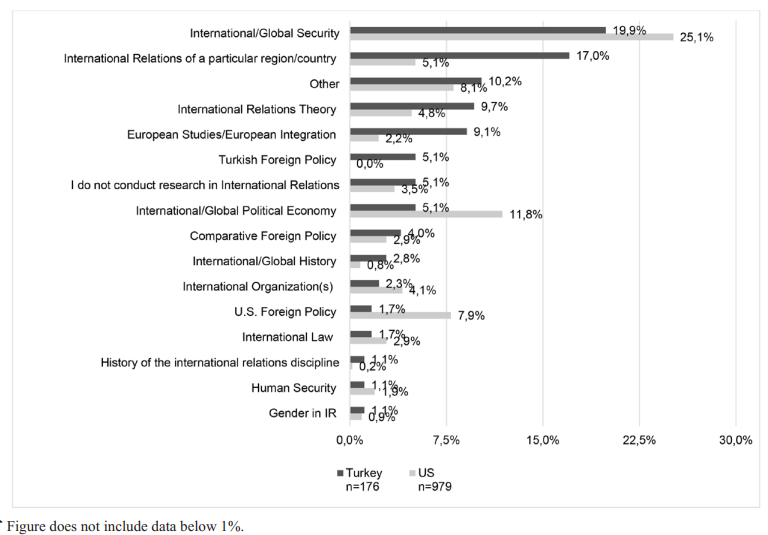
Figure 1 shows that IR scholars in Turkey and the US tend to focus on different topics in their research. While “International/Global Security” is a priority for both groups, it is slightly more important for scholars in the US (25.1%) than for scholars in Turkey (19.9%). It is worth noting that the pattern has remained unchanged since 2014, as the previous TRIP surveys conducted in 2014 and 2018 also showed the same priority being given to international security in both countries (Aydın et al., 2016; Aydın & Dizdaroğlu, 2019).
A striking contrast emerges around regional studies, where Turkish scholars overwhelmingly focus on “particular regions/countries” (17%), compared to only 5.1% in the US. As seen in Figure 2 and from the secondary research areas, the “particular country” here is obviously “Turkey” for scholars working in Turkey. Furthermore, while American scholars show a strong interest in “International/Global Political Economy” (11.8%), there is a notable gap in Turkish scholars’ engagement with this subfield, with only 5.1% indicating that they focus on it. The “other” category ranked third among respondents from Turkey (10.2%) and the US (8.1%), though analysis of the open-ended responses does not reveal a consistent or thematically unified pattern.
When asked about their secondary research areas, scholars from both countries prioritized foreign policy, with 15.8% of Turkish respondents focusing on “Turkish foreign policy” and 10.5% of American respondents focusing on “US foreign policy”. Among Turkish scholars, the second and third most cited areas remained consistent with previous patterns: international/global security and international relations of specific regions or countries. In contrast, scholars in the US cited international/global security and IR theory as their next most common secondary interests, reflecting a relatively stronger orientation towards theoretical and conceptual research.
3.2 Research Orientation: Regions, Method, and Theoretical Framework
This section examines the research orientations of scholars in Turkey and the US, focusing on the regions they study, the methods they employ, and their broader theoretical and epistemological commitments, based on responses from IR academics who participated in the TRIP 2022–23 survey. By analyzing these dimensions, TRIP 2022-23 offers insights into the intellectual tools and frameworks that shape scholarly inquiry and how research priorities differ or converge across national contexts.
Figure 2 shows a substantial divergence in regional research focus between scholars in Turkey and the US. Turkish scholars exhibit a strong national and immediate regional focus, with 22.7% studying Turkey and 15.9% studying the Middle East and Northern Africa (MENA) region, compared to 7.4% of American scholars focusing on MENA.[5]
Moreover, Turkish respondents are more likely to study Russia/the former Soviet Union (11.9%) and Western Europe (11.4%) as regions of strategic proximity. American scholars, on the other hand, take a broader global view, with significantly higher involvement in cross-regional data (19.5%), Asia (8.7%), and Latin America (8.2%), areas that receive less attention in Turkey. In TRIP-2018, Western Europe ranked second among the priorities of Turkish scholars. Still, most probably due to heightened regional tensions in the MENA region (Benli Altunışık & Martin, 2023) and around Russia (Köstem, 2022; Aydın, 2025), these regions ranked second and third in TRIP 2022-23, followed by Western Europe in fourth place. Compared to TRIP 2018, there has been a slight increase in the attention paid by Turkish scholars to East Asia (including China), from 1.3 % to 5.1 %, although still low compared to the US scholars' 8.7%. Similarly, the low attention paid by Turkish scholars to Latin America has remained unchanged since TRIP-2018 (Aydın & Dizdaroğlu, 2019, p. 11).
Figure 2. In your research, what is the main region of the world that you study, if any?
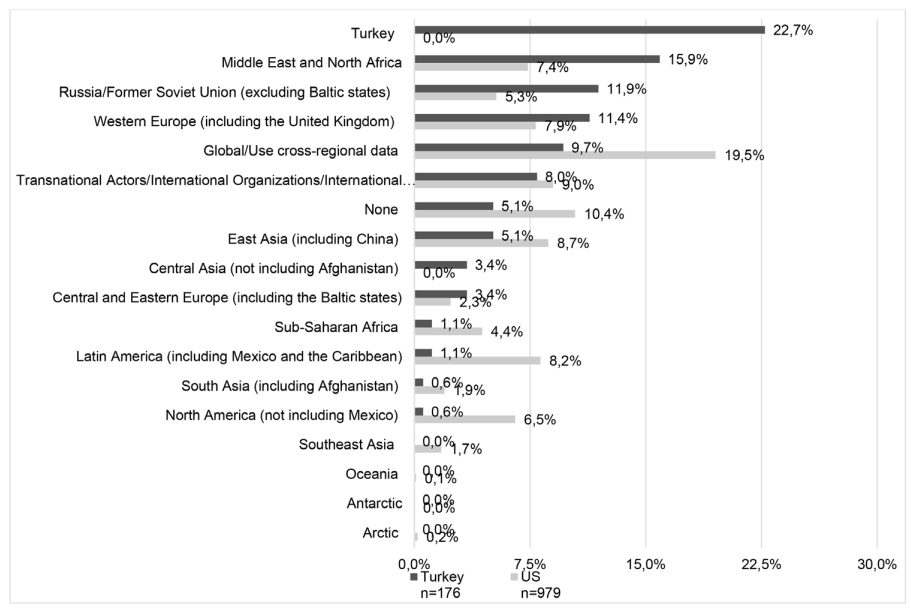
Figure 3. In your research, what method do you primarily employ?
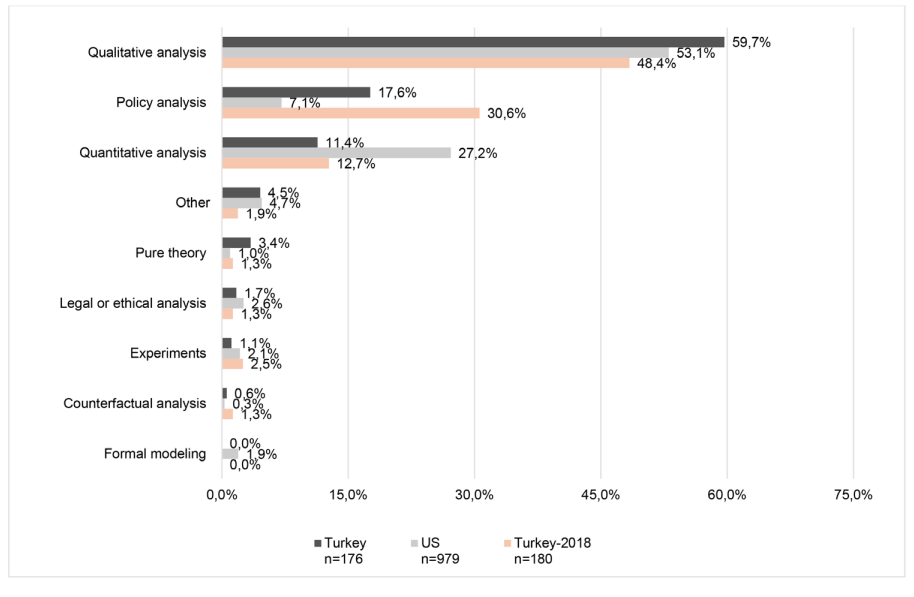
As shown in Figure 3, qualitative analysis remains the dominant methodological approach used by Turkish and American scholars, although slightly higher in Turkey (59.7%) than in the US (53.1%). However, American scholars stand out for their greater reliance on quantitative methods (27.2%), more than double that of Turkish scholars (11.4%). On the other hand, Turkish academics continue to show a significantly higher preference for policy analysis (17.6%) than their American counterparts (7.1%). However, this is a sharp decrease from the 30.6% reported in the 2018 Turkey survey (Aydın & Dizdaroğlu, 2019, p. 11). In general, Turkish scholars still show a narrower methodological range than the more methodologically diversified US scholarly community.
When scholars who reported using qualitative methods were asked which of the qualitative methods they employed, both Turkish and American scholars showed a stronger preference for comparative and single case studies. However, they differ in other methods, with Turkish scholars using more discourse and content analysis, while their American counterparts tend to use process tracing.
Figure 4. Does your research tend to be basic or applied?
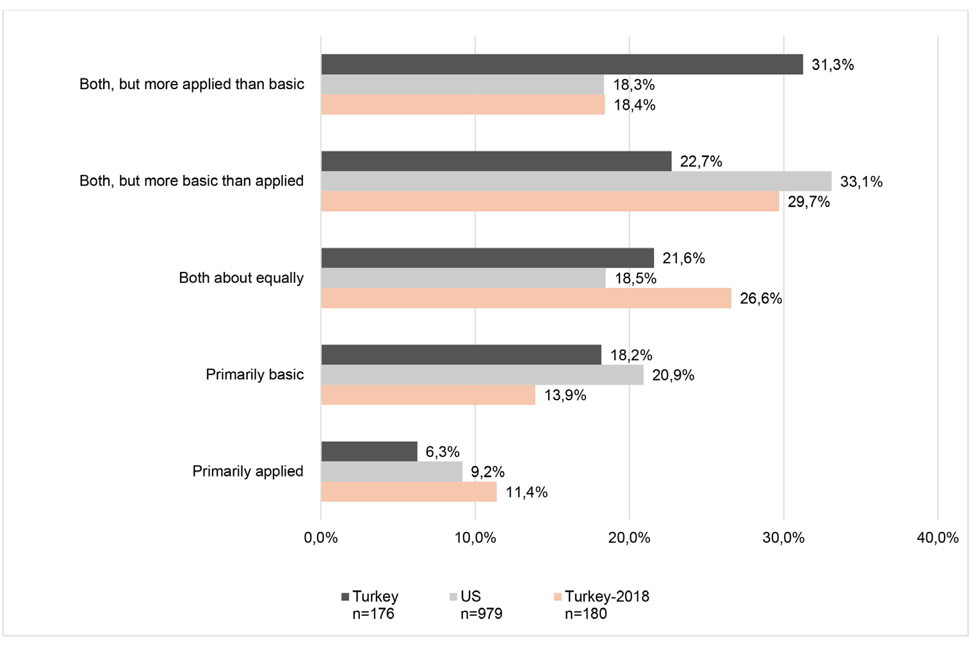
Figure 4 shows that, over time, the research orientation of Turkish scholars has shifted towards a greater emphasis on applied research. According to the TRIP 2022-23 results, 31.3% of Turkish academics described their work as “more applied than basic”, a significant increase from 18.4% in TRIP-2018. Compared to their US counterparts, Turkish scholars focus more on the applied dimension (31.3 % in Turkey vs. 18.3 % in the US) and less on the theoretical dimension (22.7 % in Turkey vs. 33.1% in the US). This shows a continuing trend since 2018, which even then revealed that “the proportion of Turkish scholars with a theoretical orientation was 5% lower than in the rest of the world” (Aydın & Dizdaroğlu, 2019:12). This development could be interpreted as growing pressure on Turkish scholars to produce practical or policy-relevant research, possibly due to regional crises and an increased demand for expert commentary. Alternatively, it could indicate an adaptation to institutional incentives and academic promotion criteria, such as publication-based performance metrics and awards for academic achievement, which emphasize the quantity and speed of research outputs. These pressures favor studies that are more applied and less theoretically dense, as evidenced by the sharp increase in faculty journals in recent years.
Figure 5. What is the primary method that scholars use to influence policy and practitioners?
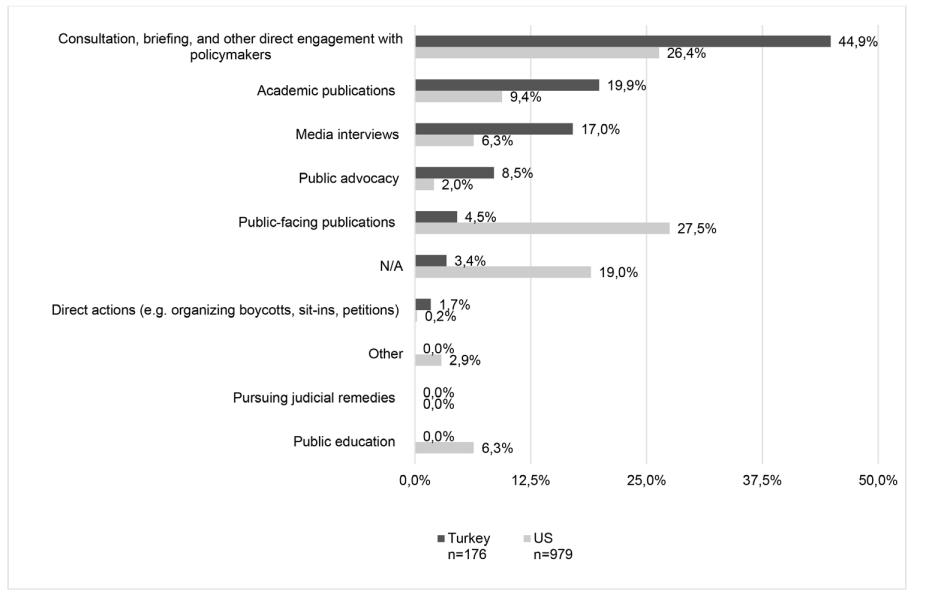
The new addition to the TRIP 2022-23 questionnaire, Figure 5, shows that the most frequently cited method of influencing policy among Turkish respondents is “consultation, briefing and other direct engagement with policymakers” (44.9%), significantly higher than the US figure (26.4%). Turkish scholars also report a greater reliance on “academic publications” (19.9%) and “media interviews” (17.0%) as means of influencing policy, compared with 9.4% and 6.3% respectively for US scholars. A detailed analysis of the tendencies of Turkish academics on media coverage is provided in another study conducted by Emre Erdoğan (2024), which supports and complements the findings of TRIP 2022-23 results. In contrast, American scholars are more likely to use “public-facing publications” (27.5%), suggesting a preference for broader, more indirect forms of influence.
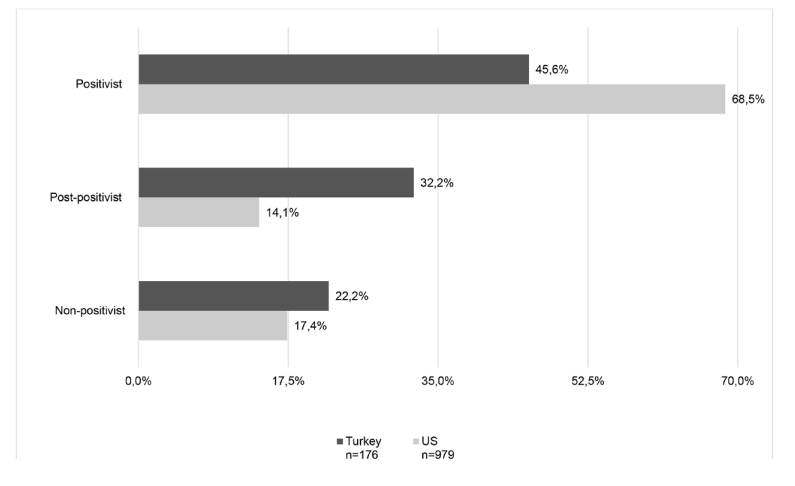
When it comes to the epistemological identification (see Figure 6), the data show that Turkish IR scholars have a more diverse and open epistemological orientation. While most American scholars (68.5%) identify as positivists, only 45.6 % of Turkish scholars do so. Instead, Turkish respondents show a stronger inclination towards post-positivism (32.2%) than their American counterparts (14.1%) and present a higher proportion of non-positivists (22.2% vs 17.4%). Interestingly, the data also reveal significant differences in the epistemological identification of IR scholars who use quantitative methods in both the US and Turkey. Based on the findings of Figure 3, US respondents who primarily employ quantitative methods in their research tend to identify as positivists (92.1%), with only 5.4% defining themselves as post-positivists. By contrast, among Turkish scholars who primarily use quantitative methods (see Figure 3), the distribution is much more balanced: 38.6% identify as positivists, 38.6% as post-positivists and 22.7% as non-positivists. Unlike in the US context, where quantitative work is overwhelmingly grounded in positivism, this pattern suggests that Turkish IR scholars tend to employ quantitative approaches within a more epistemologically pluralist framework.
Figure 6. How would you characterize your work in epistemological terms?
There is also a clear divergence in theoretical orientation between Turkish and American scholars, as shown in Figure 7. Turkish respondents are significantly more likely to align themselves with established paradigms, particularly realism (30.1%) and constructivism (27.3%), than their US counterparts (14.8% and 18.3% respectively). In contrast, a large proportion of American academics (42.4%) report not using paradigmatic analysis, whereas only 11.9% of Turkish academics do the same. The proportion of those who reported not using any paradigmatic analysis was 26% in 2014 and 26.7% in 2018 (Aydın & Dizdaroğlu, 2019, p. 13). In this context, it can be noted that this tendency has remained higher in the US and the rest of the world, in contrast to Turkey.
Figure 7. Which of the following best describes your approach to the study of IR?
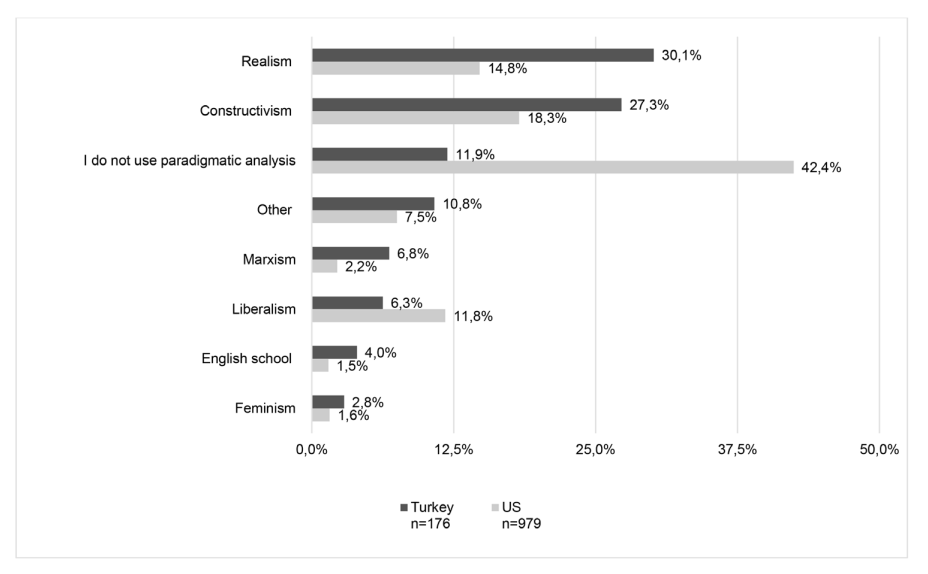
It could be argued that the differences between Turkish and American IR scholars in terms of their commitment to different paradigms and epistemological orientations reflect broader institutional and disciplinary dynamics. Turkish IR education tends to emphasize classical theoretical traditions, such as realism and constructivism (as reflected in Figure 7), thereby fostering a scholarly culture in which paradigm-based thinking remains central. As previously mentioned, Turkish scholars often prioritize applied work that addresses national concerns in a context shaped by regional security crises and geopolitical volatility (See Figure 4). Their preference for direct engagement with policymakers (44.9% compared to 26.4% in the US) and their reliance on media interviews (17.0% compared to 6.3%) as tools of influence may reinforce this applied, policy-oriented outlook.
In contrast, American scholars based at research universities operate within a more fragmented and pluralistic disciplinary environment. According to the TRIP 2022-23 data, 42.4% of American scholars reported that they do not use paradigmatic analysis, in stark contrast to just 11.9% of Turkish scholars (Figure 7). This may be interpreted as reflecting a disciplinary culture in the US that places greater emphasis on methodological innovation, normative theorizing, and interdisciplinary or critical approaches. The greater acceptance of abstract theorizing and post-positivist epistemologies among American scholars confirms this tendency. For example, only 45.6% of Turkish scholars identified as positivists, compared to 68.5% of American scholars, indicating a more diverse epistemological landscape in Turkey (Figure 6).
3.3 Academic Output Preferences, Practices, and Professional Visibility
This section examines publication practices, including citation habits, language use in scientific papers, and perceptions of journal quality. It also compares the views of Turkish and American scholars on influential journals, academic presses, and top academic programs. These findings help to identify how institutional visibility and academic authority are shaped in both countries, based on responses from IR academics who participated in the TRIP 2022– 23 survey. It should be noted that questions relating to citation practices and language use were only included in the Turkish questionnaire. This disparity is indicative of more than just a difference in survey design; it reveals a deeper epistemic asymmetry within the discipline. For US-based scholars who are firmly embedded in the disciplinary “core”, publishing in English and citing English-language sources is taken for granted as the norm. These practices are rarely questioned because they mirror the underlying structure of epistemic privilege. By contrast, Turkish scholars, positioned within a semi-peripheral academic environment, must constantly navigate issues of linguistic accessibility, institutional legitimacy, and global visibility. As mentioned at the beginning of this article, these asymmetries demonstrate the close connection between disciplinary gatekeeping and structural hierarchies, as well as their impact on the conditions for scholarly participation and recognition within the field.
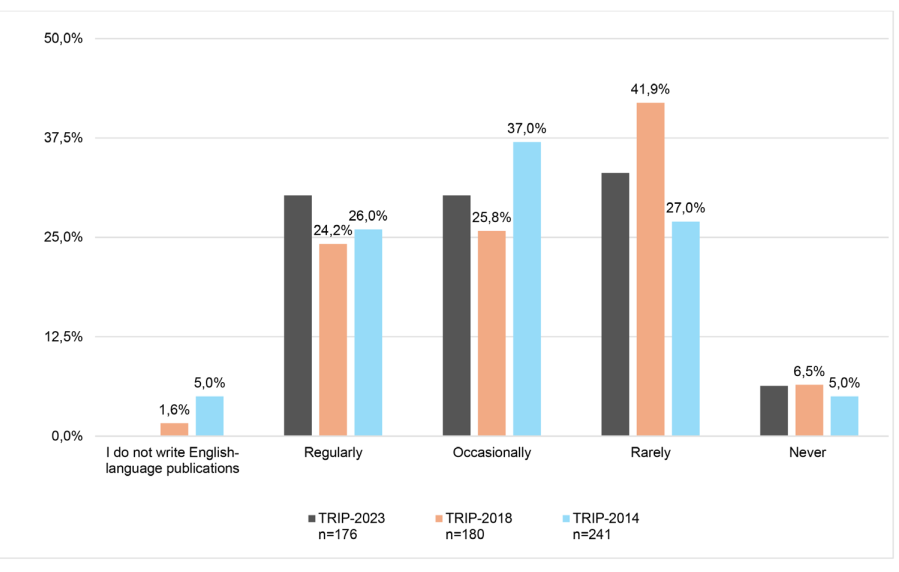
To determine the habits of scholars in citing non-English sources in their research, a specific question was asked in the TRIP-2023 survey in Turkey. Accordingly, a total of 60.6% of respondents reported citing non-English sources either “regularly” or “occasionally” (see Figure 8 below), a significant improvement from 50% in TRIP-2018 (Aydın & Dizdaroğlu, 2019, p. 14), although still below the TRIP-2014 level of 63% (Aydın et al., 2016, p. 14). The proportion of scholars who “rarely” cite such literature has fallen from 41.9% in 2018 to 33.1% in 2023. At the same time, the persistence of “rarely” and “never” responses (still totaling almost 40% in 2023) suggests that some barriers still inhibit the wider use of non- English literature in global academic discourse.
Figure 8. How frequently do you cite literature written in languages other than English when you are writing an English-language publication?
The most frequently cited concern in TRIP-2023 among the Turkish IR community, excluding non-English literature, appears to be that “readers and reviewers may not be able to trace non-English sources” (56.4%, almost identical to 57% in 2018), while other barriers have decreased significantly. For example, concerns about loss of anonymity in peer review decreased from 15% in TRIP-2018 to 3.2% in TRIP-2023 (Aydın & Dizdaroğlu, 2019, p. 15), while the belief that English-language equivalents are not readily available declined from 45% to 27.7%. This change may be due to the availability of more non-English (specifically Turkish) sources on the Internet today than a few years ago, including Turkish-language academic materials through platforms such as DergiPark as well as open-access repositories.[6] It may also be due to the growing reliance on AI-based translation tools, which make it easier for readers and reviewers to engage with non-English sources. These developments align with a broader movement in academia towards multilingual accessibility. This makes it increasingly feasible for scholars from peripheral contexts to contribute to global knowledge production.
Figure 9. Do you evaluate the quality of journal articles based on a ranking or rating system?
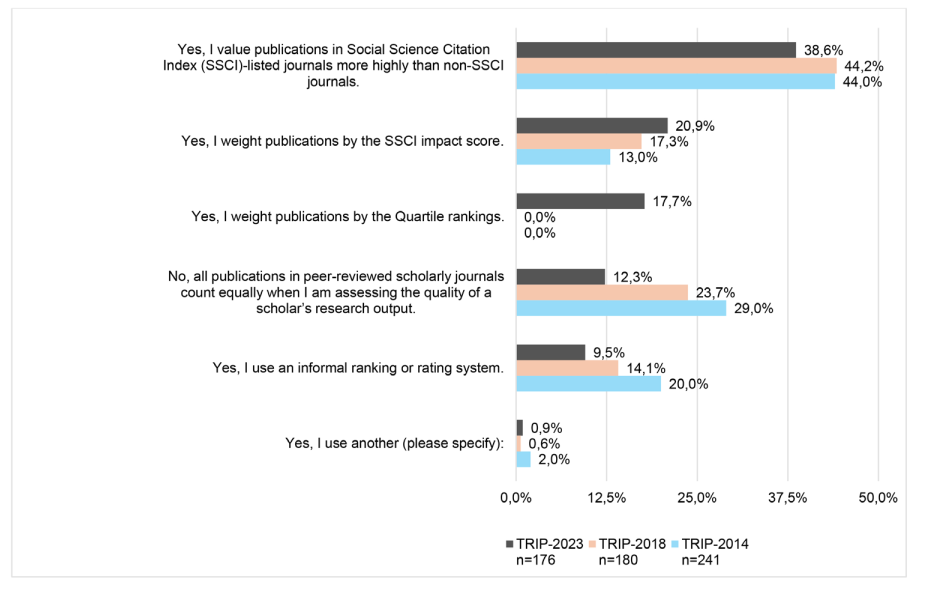
The TRIP-2023 data indicate a continued and even increased reliance on formal journal ranking systems among Turkish scholars, as well as a decline in more informal evaluation approaches (See Figure 9). The proportion of scientists who say they value SSCI-listed journals more than non-SSCI-listed journals remains dominant (38.6%), although slightly lower compared to around 44% in TRIP-2014 and TRIP-2018 (Aydın & Dizdaroğlu, 2019, pp. 17–18). There is a notable increase in those who weigh publications by SSCI impact scores (20.9%). Also, following the addition of “quartile rankings” as an option for quality indicator in TRIP-2023, a significant proportion of respondents (17.7%) reported its usage in their assessments. Judging from the frequent complaints of the Turkish IR community about the usage of indexes, impact factors or more recently quartiles by university administrations in determining academic performances,[7] the most likely reason for this change is not an increased belief/trust in these systems but their overwhelming usage by the universities and their increasing representation of quality in the eyes of the public (Aydın et al., 2016; Aydın & Dizdaroğlu, 2019).[8]
When scholars were asked about the publishing houses that most influence their way of thinking about IR, the results show a remarkable stability among Turkish scholars’ perceptions of the most influential publishing houses in IR over the last decade. “Cambridge University Press” (18.6%), “Oxford University Press” (17.5%), “Routledge” (16.7%) and “Palgrave Macmillan” (12.5) remain the top four in this order of preference, with only minor shifts in their percentages since 2014. The top four publishing houses in the TRIP 2022-23 survey of American scholars have remained unchanged since 2017: “Cambridge University Press” (22%), “Oxford University Press” (17.8%), “Princeton University Press” (15.4%) and “Cornell University Press” (13.6%) (Maliniak et al., 2017, p. 12). While the first two presses are shared by both countries, the remaining choices reveal a greater influence of US- based university presses within the American academic context. The consistency of these choices suggests that the intellectual center of gravity in the field remains firmly anchored in academic publishing in the United Kingdom (UK) and the US, and that university presses are still perceived to be more influential than commercial presses. In terms of national publishers, TRIP-2023 shows that İletişim Yayınları (24.5%) and İstanbul Bilgi Üniversitesi Yayınevi (22.7%) are perceived as the most influential Turkish publishers in shaping the way Turkish scholars think about IR. They are followed by İmge Yayınları (14.6%) and Koç Üniversitesi Yayınevi (11.8%), reflecting a mix of independent and university presses.
In terms of the international journals that have the greatest impact on scholars, TRIP- 2023 indicates a continued consolidation of Turkish IR scholars around globally prestigious journals (See Table 2). Foreign Affairs (12.1%) and International Organization (8.8%) remain among the most influential outlets, with modest increases and decreases since 2018. Moreover, International Affairs (8.3%) increased slightly, replacing International Security, which ranked third in TRIP-2018. Notably, two of the top journals cited by Turkish scholars — International Organization and Foreign Affairs — also appear among the top four selected by American scholars in the TRIP 2022-23 survey. The top four journals preferred by American scholars have also remained unchanged since 2017: International Organization (17.5%), International Studies Quarterly (12.3%), International Security (11.4%), and Foreign Affairs (7.2%) (Maliniak et al., 2017, p. 11). This overlap indicates a mutual acknowledgement of certain “core” journals within the field of global IR.
Table 2. Select the four journals that publish articles with the greatest influence on the way IR scholars think about international relations (The top 10 journals)
| TRIP-2018 n=180 | TRIP-2023 n=176 | |
| Foreign Affairs | 11.6% | 12.1% |
| International Organization | 9.0% | 8.8% |
| International Affairs | 5.8% | 8.3% |
| European Journal of International Relations | 6.7% | 7.5% |
| Foreign Policy | 4.9% | 5.3% |
| International Security | 8.0% | 5.3% |
| International Studies Quarterly | 4.3% | 4.8% |
| Millennium | 5.6% | 3.8% |
| American Journal of Political Science | 1.7% | 3.8% |
| Foreign Policy Analysis | 1.7% | 3.8% |
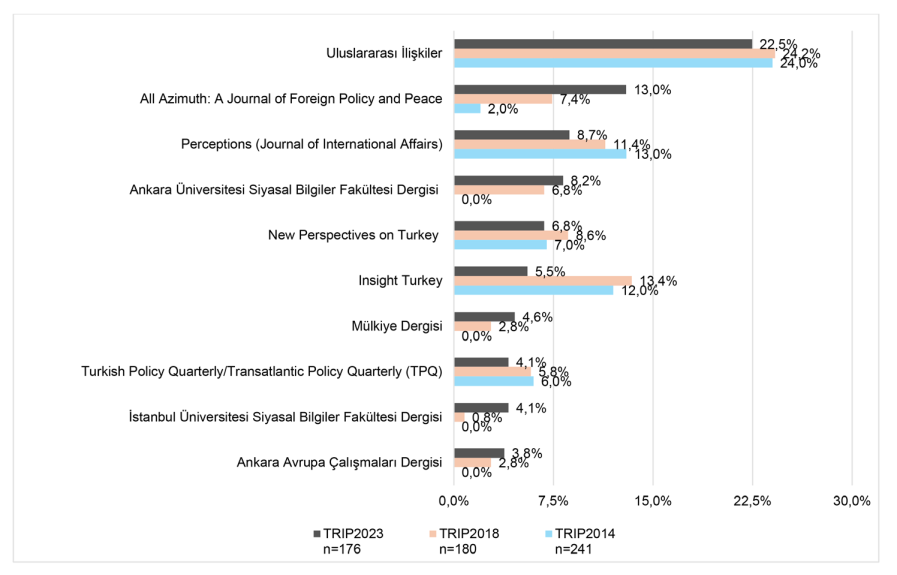
Regarding national journals (see Figure 10), the results of TRIP-2023 show that Uluslararası İlişkiler holds its top position, being mentioned by 22.5% of respondents, indicating its continuing role as a central venue for disciplinary dialogue. On the other hand, the growing importance of All Azimuth (13.0%), together with Uluslararası İlişkiler, reflects a gradual consolidation among Turkish academics towards a type of journals that are published by independent publishers and/or research centers.
While Perceptions retains its third position in TRIP-2023, it registers a relative decline in influence (from 13% in 2014 to 8.7% in 2023), as does Insight Turkey, from 13.4% in TRIP-2018 to 5.5% in TRIP-2023 (Aydın et al., 2016, p. 23; Aydın & Dizdaroğlu, 2019, p. 19). On the surface, these shifts could be seen as an academic preference, moving away from policy-oriented outlets towards journals that are perceived to have stronger academic credentials. However, this trend seems counterintuitive when considered alongside the broader shift in Turkish IR towards applied, policy-relevant research, as demonstrated by the TRIP-2023 data (see Figure 4). Possible explanations include growing concern over journals’ international indexing, institutional autonomy of publishing houses, and affiliation or connection with official institutions or political positions that somewhat delegitimize them within scholarly circles. In any case, these results indicate that Turkish scholars increasingly prioritize journals that are both policy-relevant and academically reputable, reflecting their desire to engage with practical issues while maintaining scholarly legitimacy. In addition, the continued presence of university/faculty-based journals such as Ankara Üniversitesi SBF Dergisi, İstanbul Üniversitesi SBF Dergisi, Ankara Avrupa Çalışmaları Dergisi indicates the continued relevance of traditional university-connected publishing venues.
Figure 10. Select the four national journals that publish articles with the greatest influence on the way IR scholars in Turkey think about international relations.
The findings in this section reveal a growing alignment of Turkish IR scholars with global academic norms, particularly in their increasing reliance on SSCI-indexed journals, impact metrics, and formal evaluation systems. At the same time, persistent constraints —such as language barriers— continue to shape publication and citation patterns. Taken together, these dynamics illustrate both the pressures of international academic integration and the ongoing efforts to achieve scholarly visibility in a core-peripheral context.
3.4 Strategic Outlook and Policy Engagement
This section examines the ways in which IR scholars in Turkey and the US perceive the international environment, identify key foreign policy priorities, and engage in the policy process through various channels of influence.
Figure 11. Which area of the world do you consider to be of greatest strategic importance to your country today?
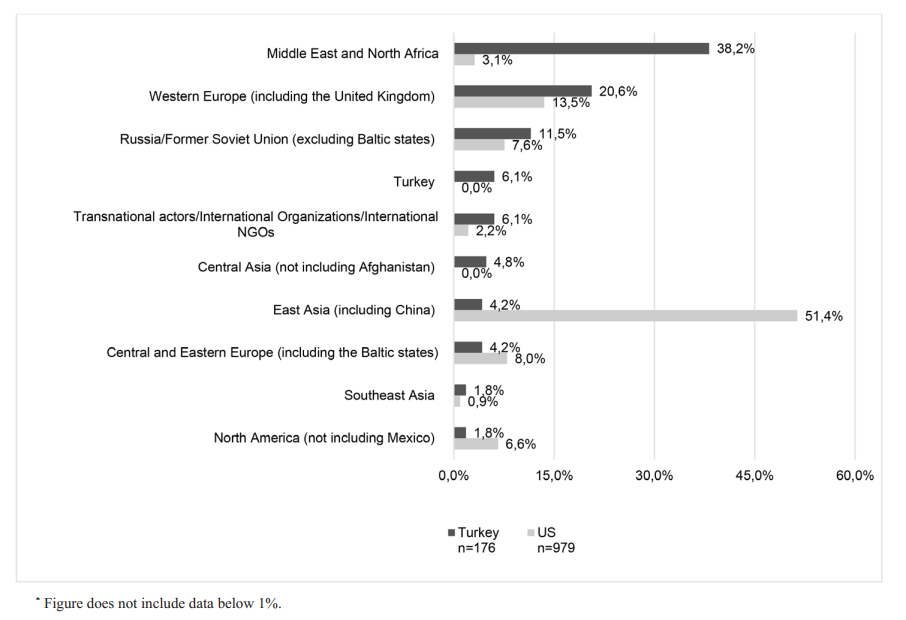
Figures 11 and 12 reveal a stark divergence between Turkish and American scholars in their perceptions of the strategic priorities and the most important foreign policy issue for their respective countries. While 38.2% of Turkish scholars identify the MENA as the most strategically important region, reflecting Turkey’s geographical proximity and ongoing regional entanglements, only 3.1% of American scholars share this view. In contrast, more than half of scholars in the US (51.4%) prioritize East Asia (including China), reflecting a global strategic focus centered on the rise of China, while only 4.2% of scholars in Turkey consider that region to be of primary importance. Turkish respondents also place greater emphasis on Western Europe (20.6%) and Russia/the former Soviet Union (11.5%), signaling a regional outlook anchored in immediate geopolitical realities, while American scholars adopt a more globalized and consolidated strategic framework.
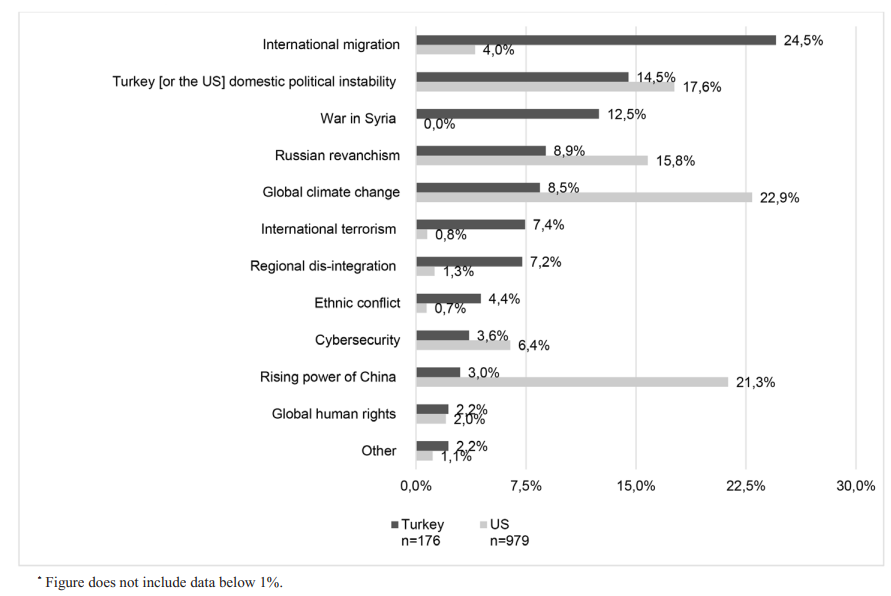
Confirming the earlier finding on scholars’ perceptions of strategic geography, the data on perceived foreign policy priorities further highlight the contrast between Turkish and American scholars (Figure 12). Turkish scholars overwhelmingly identify “international migration” (24.5%), “domestic political instability” (14.5%), and “the war in Syria” (12.5%) as the most pressing issues, highlighting an understanding of foreign policy that is deeply intertwined with domestic and regional crises. In contrast, scholars in the US prioritize broader systemic concerns such as “rising power of China” (21.3%), “global climate change” (22.9%), and “Russian revanchism” (15.8%), reflecting a global power politics lens. It should also be noted that the absence of the “war in Syria” (0%) from US responses, despite its prominence among Turkish scholars (12.5%), suggests a disconnect between domestic and international threat perceptions between Turkish and American IR scholars. Moreover, the emphasis on “US domestic political instability” (17.6%) among American scholars is likely to reflect anxieties about instability in liberal democracies more broadly, including polarization and institutional erosion in the US itself, which will be exacerbated if the survey is conducted again during the Trump presidency.
Figure 12. What are the three most important foreign policy issues facing your country today?
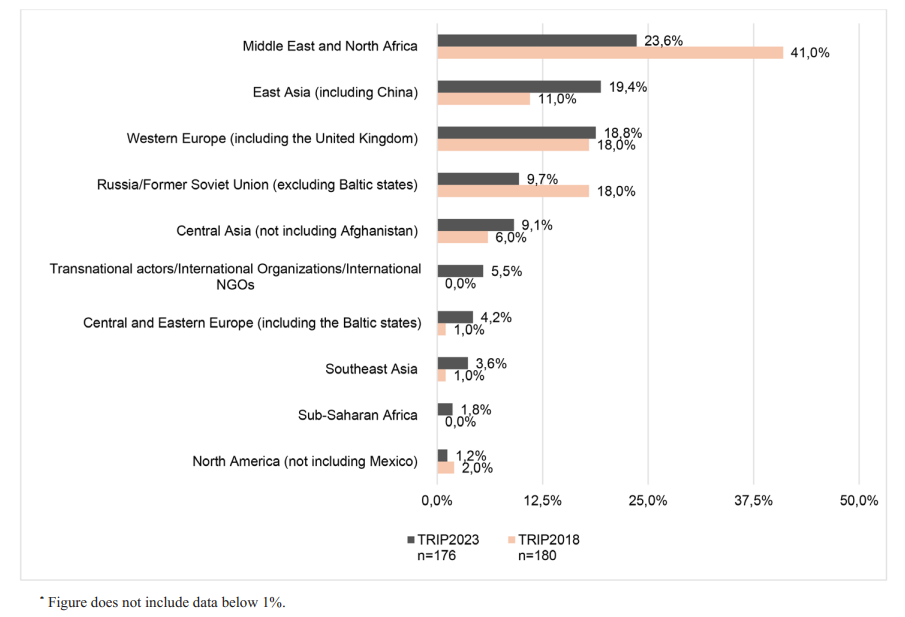
In addition to assessing current geopolitical risks for their respective countries, the TRIP- 2023 also included forward-looking questions asking IR scholars to forecast the likelihood of potential conflicts involving the US and to identify regions of long-term strategic importance to Turkey. As shown in Figure 13, there has been a notable shift in the long-term strategic outlook of Turkish scholars. While the MENA region remains the most frequently cited region for its future importance to Turkey (23.6%), its dominance has fallen sharply from 41% in 2018, suggesting a growing recognition of global power shifts beyond the immediate neighborhood. In line with this, East Asia (including China) has almost doubled (19.4%) in perceived strategic importance since 2018 (11%), reflecting heightened awareness of China’s rising influence and the broader implications of Asia-Pacific geopolitics for Turkey (Aydın & Dizdaroğlu, 2019, pp. 25–26). Finally, Western Europe maintains a stable position (18.8%), underlining its continued importance as an economic and political partner.
Figure 13. Which area of the world do you believe will be of the greatest strategic importance to Turkey in 20 years?
When scholars were asked to assess the likelihood of war between the US and either Russia or China in the next decade, responses in both countries were overwhelmingly clustered in the lower probability ranges, indicating a consensus that while tensions remain high, the prospect of full-scale military conflict is widely regarded as unlikely.
3.5. Perceptions of Academic Excellence and Recognition
This section explores how IR scholars in both Turkey and the US assess the intellectual and institutional landscape of their discipline. Accordingly, it first presents which the academic programs at the undergraduate, master’s, and doctoral levels that are considered to be best equipped to train future generations of academics and professionals. It then focuses on Turkish scholars’ perceptions of who they consider influential, both in shaping recent debates and in contributing to the historical development of the field. It should be noted, however, that the US survey does not include questions on the perception of influential scholars, making this dimension unique to the Turkish dataset.
Looking at the ranking of the best universities in the US at Master’s level for students interested in a policy-career in IR, the top 5 Master’s programs for the US scholars are Georgetown (16.2%), Johns Hopkins (12.7%), Harvard (11.3%), Columbia (8.5%) and Princeton (7.4%) universities; while Turkish scholars chose Harvard (14.0%), London School of Economics and Political Science (9.9%), Oxford (8.8%), Princeton (7.4%) and Georgetown (6.3%) universities (Blanes, Peterson, & Tierney 2024). It appears that US academics show a strong preference for domestically based programs in the Ivy League institutions, while Turkish academics also reflect some of the UK institutions in their preferences.
Table 3. What are the five best Ph.D. programs in the world for a student who wants to pursue either an academic career or a policy career in International Relations?
| US n=979 | Turkey n=176 | ||
| Academic-career | Policy-career | Academic-career | Policy-career |
| Harvard University (13.5%) | Harvard University (14.0%) | Harvard University (14.1%) | Harvard University (13.9%) |
| Princeton University (12.6%) | Georgetown University (12.7%) | University of Oxford (10.8%) | University of Oxford (9.8%) |
| Stanford University (12.4%) | Princeton University (8.4%) | Princeton University (10.1%) | University of Cambridge (7.3%) |
| Columbia University (8.0%) | Johns Hopkins Universi-ty (7.4%) | University of Cambridge (8.3%) | LSE (7.3%) |
| University of Chicago (5.8%) | Columbia University (7.6%) | LSE (7.9%) | Princeton University (6.9%) |
When it comes to academic and policy-oriented PhD programs for future IR scholars and practitioners, the responses of both American and Turkish respondents are dominated by Anglo-American institutions (See Table 3). It is clear from the responses of IR scholars that Harvard and Princeton universities appear consistently on all lists, reflecting their dual reputation for academic excellence and policy influence in the field of IR. For academic PhD programs, scholars in the US overwhelmingly favor leading American research universities –Harvard, Princeton, Stanford, Columbia, and the University of Chicago– underlining the centrality of the US academic system in shaping disciplinary scholarship. Turkish scholars, while recognizing Harvard and Princeton, show a clear preference for leading British institutions, including Oxford, Cambridge, and the LSE.
For doctoral programs geared towards policy careers, American scholars continue to focus on the American policy circuit, highlighting schools such as Georgetown and Johns Hopkins, which are known for their connections to Washington, D.C., and practitioner- oriented training. In contrast, Turkish scholars present a more institutionally diverse and internationally dispersed vision, shaped by broader global affiliations beyond the US policy circuit.
Table 4 confirms that undergraduate IR education in Turkey has shown both stability and subtle shifts in institutional prestige over the past decade. Among the top ten institutions, five are public and five are foundation universities, reflecting a balanced representation between long-established public and relatively newer foundation universities. Bilkent University and Middle East Technical University consistently remain among the top three, while Koç University has seen a steady increase in recognition since 2014. Boğaziçi University continues to be seen as a strong institution, but its share has gradually declined from 14% to 11%, possibly reflecting recent concerns about institutional autonomy. On the other hand, Sabancı University has a stable position around 10% and Kadir Has University has had a modest gain, indicating a wider recognition of alternative foundation institutions. Ankara University, one of the oldest public universities with a legacy in the field, has registered a gradual decline in recent years from 10% in 2014 to 5% in 2023.
Table 4. What are the five universities in Turkey for undergraduate students to study International Relations? (Top 10 universities)
| University Type | TRIP-2014 n=241 | TRIP-2018 n=180 | TRIP-2023 n=176 | |
| Bilkent University | Foundation | 15% | 16% | 16% |
| Middle East Technical University | Public | 19% | 17% | 15% |
| Koç University | Foundation | 10% | 12% | 15% |
| Boğaziçi University | Public | 14% | 14% | 11% |
| Sabancı University | Foundation | 8% | 10% | 10% |
| Kadir Has University | Foundation | 5% | 8% | 7% |
| Ankara University | Public | 10% | 8% | 5% |
| İstanbul Bilgi University | Foundation | 3% | 3% | 3% |
| İstanbul University | Public | 3% | 3% | 3% |
| Galatasaray University | Public | 1% | 1% | 3% |
These patterns broadly align with those of international university rankings, such as the Times Higher Education (THE) rankings. According to the 2023 THE rankings, five Turkish universities — Koç, Sabancı, Middle East Technical, Bilkent and Boğaziçi — were among the top 1,000 universities worldwide. While Istanbul University and Ankara University were ranked in the 1001-1500 range, three universities — Kadir Has, Istanbul Bilgi and Galatasaray — were not listed. Notwithstanding the criticism of the methodology of the rankings and the fact that THE only lists universities participating in its survey, thus causing fluctuations each year, the correlation between national perceptions and international standing in 2023 results loosely indicates the continued importance of long-standing institutions and the gradual diversification of prestige within Turkey’s IR education landscape.
Tables 5 and 6 present the findings of questions posed to Turkish respondents only, as they were not asked this year in the US. Thus, only a comparison of the TRIP-2014 and TRIP-2018 results for Turkey was presented. Table 5 presents the results of the open-ended question to identify up to four scholars who, in the respondents’ opinion, have produced the most influential or interesting scholarship in the field of IR in Turkey in recent years.
Regarding national level academic influence with their writings, Ziya Öniş and Pınar Bilgin continue to be recognized as leading figures, while Öniş increases in prominence (from 7.7% 2018 to 10.4% in 2023) and Bilgin maintains a strong presence (9.1%), reflecting their sustained contributions to political economy and critical IR sub fields. Bahar Rumelili and Mustafa Aydın also remain among the most cited, indicating their continued relevance, while the growing recognition of Evren Balta, Senem Aydın-Düzgit, Özgür Özdamar, Seçkin Köstem and Ali Balcı might point to the beginning of a gradual generational change, as these scholars earned their PhDs after 2006, in contrast to earlier figures who completed their doctorates in the early 2000s or before.
Table 5. Aside from you, please list four scholars who have produced the most influential/interesting scholarship in recent years in IR in Turkey
| Ph.D. Degree/ Year | TRIP-2014 n=241 | TRIP-2018 n=180 | TRIP-2023 n=176 | |
| Ziya Öniş | 1984 | 10.4% | 7.7% | 10.4% |
| Pınar Bilgin | 2000 | 19.8% | 11.0% | 9.1% |
| Bahar Rumelili | 2002 | 7.3% | 5.4% | 6.3% |
| Mustafa Aydın | 1994 | 15.6% | 6.5% | 5.1% |
| Evren Balta | 2007 | - | 1.8% | 4.8% |
| Senem Aydın-Düzgit | 2008 | 2.1% | 3.6% | 4.3% |
| Özgür Özdamar | 2006 | 0.3% | 1.8% | 3.5% |
| Ersel Aydınlı | 2002 | 1.0% | 1.8% | 2.3% |
| Seçkin Köstem | 2016 | - | - | 2.3% |
| Ali Balcı | 2010 | - | 0.3% | 2.0% |
Table 6. Aside from you, please list four scholars who have most contributed to the development of the IR discipline in Turkey
| Ph.D. Degree/ Year | TRIP-2014 n=241 | TRIP-2018 n=180 | TRIP-2023 n=176 | |
| Mustafa Aydın | 1994 | 10.1% | 16.0% | 26.4% |
| Ziya Öniş | 1984 | 6.1% | 5.7% | 9.3% |
| Pınar Bilgin | 2000 | 12.1% | 8.2% | 8.5% |
| Bahar Rumelili | 2002 | 4.0% | 2.0% | 5.6% |
| Ersel Aydınlı | 2002 | 2.3% | 1.1% | 4.5% |
| Faruk Sönmezoğlu | 1980 | 1.2% | 8.2% | 2.6% |
| İlter Turan | 1966 | - | 3.1% | 2.6% |
| Meliha Altunışık | 1994 | 3.2% | 1.1% | 2.6% |
| Meltem Müftüler Baç | 1992 | 1.7% | 2.6% | 2.6% |
| Baskın Oran | 1974 | 0.9% | 6.5% | 2.4% |
| Fuat Keyman | 1991 | 5.2% | 3.4% | 1.9% |
| Faruk Yalvaç | 1981 | 3.5% | 2.3% | 1.9% |
| Ali Karaosmanoğlu | - | 0.3% | 5.4% | 1.6% |
| Atila Eralp | 1983 | - | 3.1% | 1.3% |
| Kemal Kirişci | 1986 | 2.6% | 1.7% | 0.8% |
* The top 10 academics are listed based on the TRIP-2023 results. The other names in the table are included because they were among the top 10 academics in previous years.
Table 6, which lists scholars who have most contributed to the development of the IR in Turkey confirms a strong continuity in perceptions among similar scholars. Accordingly, Mustafa Aydın (26.4%), Ziya Öniş (9.3%), and Pınar Bilgin (8.5%) remain as the most frequently cited academics, holding prominent positions, reflecting their enduring influence in shaping both institutional structures and scholarly debates within Turkish IR. The weakening memory effect with generational change should also be noted here as the formerly influential scholars, once they retire from their offices, tend to slip down the list, perhaps reflecting short-termism in perceptions among Turkish IR academics. Additionally, the upcoming academics listed in Table 5 who are gaining influence through their writing do not yet appear in Table 6, highlighting the generational impact on the shaping of institutional structures.
4. Conclusion
This study draws on the TRIP 2022-23 survey to explore how IR scholars in Turkey and the US conceptualize their disciplinary identity, choose methodological tools, engage with strategic issues, and navigate the structures of academic recognition. The findings reveal a discipline at a semi-peripheral crossroads: while Turkish scholars demonstrate a growing engagement with globally dominant publication standards and theoretical paradigms, their preferences in methodology, regional focus, and policy relevance remain deeply rooted in local institutional cultures and geopolitical specificities. Compared to their American counterparts, Turkish scholars show a stronger orientation towards qualitative and policy-oriented research, a more regionally embedded understanding of international affairs, especially in relation to the MENA region and Turkey’s foreign policy, and a greater reliance on traditional paradigms such as realism and constructivism.
At the same time, the findings from previous surveys point to a slowly diversifying and internationalizing scholarly community in Turkey. Shifts in English-language publishing habits, increased recognition of globally active Turkish scholars, and the continued rise of locally based but internationally visible academic journals suggest that Turkish IR is slowly expanding its presence within global academic conversations. However, these patterns also raise new questions about the degree of epistemological and methodological pluralism in Turkish IR, and whether integration into global publication circuits is accompanied by substantive transformations in how knowledge is produced.
These findings suggest that Turkish IR remains positioned at the intersection of global disciplinary hierarchies, exhibiting both the incorporation of core institutional norms (such as a preference for Anglo-American journals and paradigms) and the persistence of local epistemic and applied orientations. The continued reliance on realism and constructivism, as well as on regionally focused research and policy engagement, reflects a field that is responsive to geopolitical imperatives and national academic pressures. At the same time, the increasing participation of Turkish scholars in global publishing outlets suggests their partial integration into the main channels of academic prestige.
Returning to the questions raised in the introduction — how scholars at the margins engage with the core and whether this results in transformation or reproduction — this study suggests that Turkish international relations (IR) scholars adopt hybrid strategies, aligning with global norms while retaining distinctive institutional and methodological characteristics. In this sense, Turkish IR embodies the dilemmas of the semi-periphery in global knowledge production, representing a unique perspective within the broader global context. This article contributes to the Global IR literature by mapping the uneven and often contradictory processes of engagement, adaptation and constraint that shape disciplinary identities across borders, rather than advocating for simple inclusion.
While the results of TRIP-2023 provide a comprehensive overview of the methodological, epistemological and institutional contours of Turkish IR, as noted above, they are based primarily on survey data. Quantitative data is useful for capturing broad trends and comparative insights, but it cannot fully capture the qualitative nuances of academic careers, institutional cultures or generational dynamics within departments. Moreover, more representative data would be necessary to assess the overall patterns of the discipline with greater precision. Further research benefiting from mixed methods approaches that complement survey findings with in-depth interviews would help to better understand how academic practices are shaped in detail.
Notes
[1] Throughout this article, the terms “Turkish” and “American” scholars refer to scholars based in Turkey and the United States, respectively, regardless of their ethnicity, nationality or citizenship. As such, “Turkish IR” refers to both the IR discipline in Turkey and, at the same time, the people (i.e., IR community) working in IR-related departments in Turkey. [2] Ethical approval for the survey was granted by the Committee for the Protection of Human Subjects at William and Mary College on January 5, 2023. [3] The participation rates from Turkey in previous surveys were 19% (2018), 40% (2014), 49.8% (2011), 25.7% (2009) and 14% (2007). [4] For details of the US survey, visit https://trip.wm.edu/research/faculty-surveys. [5] “Turkey” was included in the MENA region in the US version of the survey. [6] A 2009 UNESCO report in 2008 found a steady decline in the percentage of webpages in English, from 75 percent in 1998 to 45 percent in 2005. See Daniel Pimienta, Daniel Prado, and Álvaro Blanco, “Twelve years of measuring linguistic diversity in the Internet: balance and perspectives”, UNESCO, 2009. By 2025, the figures appear as 49,4 % for English and 1,8 % for Turkish (11th place). See https://www.statista.com/statistics/262946/most-common-languages-on-the-internet/. Similarly, with 4,825,138 average daily page views, Turkish stood 13th by August 2024 at Wikipedia contents. See https://en.wikipedia.org/wiki/Languages_used_on_ the_Internet. [7] For widespread complaints and the overwhelming consensus among the Turkish IR academia on this issue, see the report by IRTC from its Meslektaş Sohbetleri (“Collegial Chats”) event, conveyed at Bilgi University on 17 February 2024, at https://www.uik.org.tr/haberler/uluslararasi-iliskiler-konseyi-dernegi-bunyesinde-gelistirilen-meslektas-sohbetleri-toplantilarinin-birincisi-gerceklestirildi. [8] 8 For a detailed insight into the attitudes of Turkish academics towards publication and rankings, also see Erdoğan, E. (2024). Türkiye’deki Siyaset Bilimi ve Uluslararası İlişkiler Akademisyenlerinin Yöntemsel Tercihleri, and Al, U. and Soydal, İ. (2014). Akademinin Atıf Dizinleri İle Savaşı. Hacettepe Üniversitesi Edebiyat Fakültesi Dergisi 31(1), 23–42.
