

At the start of his term as the 47th President of the United States, Donald Trump, in his inaugural address, emphasized his conviction that God had saved him to fulfill the purpose of making America great again, heralding the beginning of a new American Golden Age. This sense of chosenness was echoed not only by him but also by his supporters, both verbally and symbolically, throughout his presidential campaigns, peaking after the July 13, 2024 attempt on his life in Butler, Pennsylvania. Both Trump’s first and second inaugural addresses employed Christian nationalist rhetoric, but the most important continuity in his overall rhetoric was an ongoing, unnamed crisis. Although Trump is not a fervent practitioner of religion, his Scottish-Protestant heritage provides a plausible cultural backdrop for his rhetoric of divine selection, which echoes a Calvinist theology of predestination. Furthermore, despite never explicitly identifying as a Christian nationalist, his rhetoric aligns with certain elements of Christian nationalist discourse by attributing the perceived decline of the United States to bureaucratic and political elites, whom he portrays as self-serving and disconnected from the needs of ordinary Americans, and then promising a Golden Age as a remedy. This alignment has garnered him support from Christian nationalist groups, who view him as central to God’s plan to usher in a new era of Christian dominion both in the U.S. and globally. After re-assuming office in 2025, Trump has shown recognition of this support through pardoning the individuals connected to the January 6, 2021 riots, an event widely interpreted as reflecting and intensifying Christian nationalist influence.
Previously, Trump’s inaugural addresses had already reflected themes resonant with Christian nationalist discourse. In his first address, he cited Psalms 133:1 to call for national unity, and framed his presidency as one that would transfer power from Washington, D.C., to the American people through the dismantling of what he termed the deep state. In his second address, he called for a “revolution of common sense” to restore the United States. This rhetoric reflects an underlying legitimacy crisis stemming from a perceived decline of rational-legal authority in the face of profound social changes. Modern nation-states typically derive legitimacy not only from popular consent but also through procedural adherence to codified laws, constitutions, and democratic norms, which signal that authority is exercised according to recognized rules rather than arbitrary power (Peter, 2023). Recent political developments in the United States, however, illustrate the erosion of these foundational tenets, often linked to the rise of Christian nationalism as a perceived threat to democracy (Saiya, 2023, pp. 102-107). Along the lines of blood and soil, Christian nationalism is broadly characterized as a fusion of Christianity and ethnic nationalism rooted in a perception of the United States as a Christian nation from its inception or, for those who take an opposing view, in the rejection of this notion. Yet this one-dimensional perspective often simplifies the historical narrative by overlooking conflicting strands of thought and disregarding social change when attempting to explain or justify current phenomena by referencing historical origins.
To address this gap, this study introduces the Khaldunian concept of asabiyyah (social cohesion), rooted in historical sociology, as a framework for understanding Christian nationalism beyond essentialist discussions. Asabiyyah, often translated as social cohesion, refers to the collective bond of solidarity that underpins the legitimacy of authority, with its ultimate goal being the attainment of mulk (sovereignty/state). It exists along a spectrum: strongest in rural or nomadic contexts (badawah), where harsh material conditions of survival foster solidarity based on blood, kinship, or something akin to it (nasab-based); and weaker in urban settings (hadarah), where material abundance reduces interdependence, and solidarity instead forms around shared goals or interests (sabab-based). Religion cannot spread or endure without a pre-existing asabiyyah. However, when asabiyyah is joined with religious belief, it produces the most powerful and durable form of cohesion. This framework makes clear that religion does not generate authority on its own but requires asabiyyah to carry and institutionalize it in the form of mulk. In this light, Christian nationalism in the United States can be understood as a bond of cohesion that seeks to restore legitimacy through the fusion of religious identity with national belonging.
This approach is particularly valuable for several reasons: (1) by accounting for social change, asabiyyah provides a dynamic and adaptive understanding; (2) it shifts the focus from static, outdated, or fragmented identities to the processes of social cohesion; and (3) it challenges the constraints of modernist epistemology and ontology, extending the analysis units beyond the boundaries of nationalism or the nation-state. To achieve this, the study employs the following methodology: first, it adopts the logic of Ibn Khaldun’s umran theory, abstracted and adapted to fit contemporary contexts; it applies a theoretical framework to explain Christian nationalism in the United States by tracing the development of Protestant disestablishment and key social changes that are found in Khaldun’s five stages. Through the integration of asabiyyah, this study provides a novel explanation of Christian nationalism, situating it within historical and social change while reframing its role in contemporary crises of national identity and legitimacy. Thus, the legitimacy crisis of the modern nation-state in the U.S. has paved the way for Christian nationalism, which can be better understood through the lens of asabiyyah.
To lay it out, the remainder of the paper proceeds in four parts. The first section defines and analyzes Christian Nationalism. It details its core tenets, historical ‘resurgence,’ and fragmentation, and concludes by identifying it as a potent, rival asabiyyah emerging from a legitimacy deficit. Having defined the paper’s central phenomenon, the second section situates nationalism within the limitations of the Western-centric nation-state framework. The third section examines the legitimacy crisis of the U.S. nation-state at both national and international levels. Building on this, the fourth section introduces the full theoretical framework of Ibn Khaldun’s asabiyyah and its cyclical dynamics, applying this lens to the U.S. case to explain the structural decline of the established liberal order. The conclusion reflects on the broader implications of this reframing for understanding legitimacy, cohesion, and the future of political order in the United States and beyond.
Christian nationalism in the United States merges two key identifiers: Christianity and American civic life. As a cultural framework, it is argued to be a more reliable predictor of political attitudes than race or party affiliation (Whitehead & Perry, 2022, pp. 10-40). The interplay between personal faith certainty and political identity drives individuals to embrace Christian nationalist ideas, with those who strongly identify with it often exhibiting unwavering belief in God (Cooper-White, 2022, p. 15). This sentiment is amplified by a belief in a cosmic battle that mirrors earthly power struggles (Ritchie, 2021, p. 61) —exploiting existential anxieties to mobilize adherents, as evidenced in the January 6 Capitol insurrection.
The mobilization of Christian nationalism is rooted in perceptions of Christian persecution, which foster discriminatory attitudes toward outgroups (Broeren & Djupe, 2024). When salient, this bias manifests as in-group preference, often linking Christian nationalism to skepticism toward science and opposition to educational content like critical race theory (Baker et al., 2020). This basis aligns with populist movements that intertwine Christian identity with race, gender, and political ideology and challenge the notion of religion as a private and non-political matter (Miller, 2021, pp. 82-85). The question of “Who Are We?” (Huntington, 2005) is answered through justifications derived from dual heritage, drawing on founding myths and identity. This often involves hermeneutics that evaluate Christian and Enlightenment values dichotomously, each used to justify exceptionalism.
Some scholars argue that the notion of Christian nationalism in the founding myths is a myth itself, as the Constitution is secular (Seidel, 2019, p. 89) and basing exceptionalism on a biblical foundation is historically unfounded (Boyd, 2007, pp. 88-90) and revisionist, disregarding the founding fathers’ rejection of state religion (Gorski & Perry, 2022, p. 162). The merging of evangelical iconography with nationalist and militaristic symbolism creates a distinct vision of Christian masculinity and national destiny, leading to a radical reimagining of the Christian roots of the U.S. (Du Mez, 2020, p. 142). By shaping apocalyptic rhetoric within the movement, this vision has the potential to mobilize extremist political behavior (McDonald, 2010, p. 56).
Although Christian nationalism’s racialized and settler-colonial expressions are often traced to the 19th century (Gorski & Perry, 2022, p. 56), when enduring conflicts between religious and secular forces throughout U.S. history are considered, it is futile to search for a single moment when the notion of a Christian America was invented (Williams, 2016, p. 399). However, The Institutes of Biblical Law (Rushdoony, 1973, pp. 8-9) articulated a vision of society based on a “sovereignly dictated order of life” and a “plan for dominion under God,” thereby providing a theological foundation for the belief that Christians must exercise authority over all civil institutions. This theological imperative of Christian reconstructionism contributed to the contemporary political movement of Christian nationalism, especially following historical battles over public education and church funding (Stewart, 2020, pp. 310-312). As the movement gained momentum, it began to view dominionism —the belief that Christians must govern over nonbelievers— as a means of addressing America’s social problems (Goldberg, 2006, p. 8).
Despite existing measurement tools, which often reduce Christian nationalism to a conflation of multiple religious concepts, there is a need for theoretical clarity (Davis, 2023, pp. 2-6). It is suggested to redefine it as a dual ideology: Christian statism, an ethno-theocratic, state-centric vision where the federal government should enforce Christian dominance and religious traditionalism, society-centric cultural conservatism (Li & Froese, 2023). The literature on Christian nationalism typically conceptualizes it as a fusion identity of religious faith and national belonging, often justifying its existence through historical records and legal documents. This approach typically results in essentialist binaries —such as whether the U.S. has ‘always’ been a Christian nation or a secular one— and overlooks the diversity of beliefs within the movement (Smith, 2024).
Those emphasizing the personal faith of the founding fathers often point to early legal documents like the Mayflower Compact and colonial charters (Federer, 2003) to argue that there is a Christian history untold (DeMar, 1995), taking this as the basis for future restoration (Torba & Isker, 2022). However, conflating Christianity with nationalism is thought to distort genuine faith by binding it to constructed narratives of national belonging in Kierkegaard’s critique (Backhouse, 2011). To substantiate the paper’s thesis of a resurgence, it is necessary to first systematically outline the historical trajectory this implies. Christian nationalism historically functioned as an overarching asabiyyah, reinforcing social cohesion and patriotic sentiment without being fully institutionalized in politics. This represented a broadly accepted, habitualized cultural phase.
This singular asabiyyah began to retreat, however, with the rise of theological and later secular existentialism and the post-1960s epistemological shift emphasizing radical individualism. Fueled by culture wars, this shift politicized Christian identity, reorienting it from a broad moral framework. As a result, Christian nationalism ceased to function as a singular asabiyyah and fragmented, turning into a contested political force. The resurgence we witness today is the result of this fragmentation. This politicization produced two primary, competing forms based on divergent responses to the new individualism. The first form, the focus of this article, evolved into conservative nationalism. Its primary characteristic is its reactive mobilization against the perceived decay of the liberal establishment and the erosion of America’s internal moral order. It evolved in this direction because it seeks to restore a perceived lost cohesion by asserting dominion and merging religious authority with state power. In direct contrast, the second form manifested in liberalized Christian movements. Its characteristic is its alignment with the individualistic shift, reframing Christian identity around emphasizing social justice and evolving to challenge established social hierarchies rather than seeking to restore a perceived traditional order.
In this framework, what is considered right or wrong, legitimate or illegitimate, is determined by subjective reasoning rather than objective standards, suggesting that moral judgments are made based on individual perception and personal experiences (Hunter, 1991, pp. 125-126). This basis for culture wars with the transition from finding meaning to meaning-making is essential, as it is part of two broader trends: methodological secularization (Marsden, 1994, pp. 150-165; Martin, 2005) and habitualization. Religion, stripped of its deeper theological significance, was transformed into an objectifiable habitus, as a set of practices and symbols that could be standardized and institutionalized. This process was especially evident in the 1950s, in events such as adoption of the phrase ‘In God We Trust’ as the national motto by Congress on July 30, 1956, which not only symbolized a unified national identity but also exemplified how religious expressions were rendered habitual, paving the way for their later politicization by groups like the Moral Majority in the 1970s. This transformation reflects the Khaldunian cycle, where an initially unifying asabiyyah weakens and fractures as both religious and nationalist sentiments weaken.
Through a Khaldunian lens, these dynamics illustrate the cyclical trajectory of asabiyyah. Ibn Khaldun locates the strength of solidarity in material conditions, where groups bound by shared hardship and collective struggle for preservation display the greatest cohesion. Conversely, when conditions of abundance replace those of survival, solidarity weakens, leaving space for rival groups to crystallize. Contemporary empirical studies suggest that significant segments of the American population currently perceive such conditions of hardship with economic dislocation, cultural threat, or existential insecurity. The Hidden Tribes (Hawkins et al., 2018) study documents this fragmentation into seven belief-based clusters, with the politically mobilized wings of Progressive Activists and Devoted Conservatives standing in sharp contrast to the larger, less engaged Exhausted Majority. These cultural cleavages reveal not only the tribalization of worldviews but also the capacity of the wing segments to generate heightened cohesion and political mobilization.
From this perspective, the long trajectory of U.S. political development since the New Deal can be understood as a liberal-progressive polity, or dawla[i] (Lewis, 1982; Orwin, 2018), that has gradually lost its binding asabiyyah by producing the conditions for a legitimacy deficit in which alternative solidarities press forward. This deficit is empirically underscored by findings that the average American’s political preferences have a “near-zero” impact on public policy, which is instead dominated by economic elites and organized interests (Gilens & Page, 2014, p. 572). Hence creating the very conditions Trump referenced in his inaugural addresses for a transfer of power to the common people. This underpins a weakening of asabiyyah in which citizens lack a shared purpose, solidarity, and mutual support, while economic elites and organized interests dominate decision-making, leaving the polity unable to function as a coherent society. Cyclically, when asabiyyah weakens, others gain the opportunity to rise; in the contemporary United States, Christian nationalism has emerged as a particularly potent contender, fusing religious identity with national destiny and aspiring to seize mulk. Having defined the specific phenomenon of Christian nationalism, the analysis must now situate it within the broader, often-critiqued Western framework of ‘nationalism’ itself, which is the subject of the next section.
Conceptualization of nationalism is often tied to specific geographical, historical, and structural contexts—namely, the West, modernity (Gellner, 1983; Anderson, 1983; Hobsbawm, 1990), and the nation-state. Conceptualization of nationalism primarily through the lens of identity reinforced the Western experience as unparalleled and inherently superior. This Western-centric narrative positions Western identity and its associated political developments —such as the nation-state— as the pinnacle of human political and cultural organization, portraying them as both universal and exceptional (Chakrabarty, 2000; Osiander, 2001) effectively transforming nationalism into a form of “civilizationism” (Brubaker, 2017, p. 1193).
At the core of this shared Western identity lies the collective historical experience of Christianity, facilitating the emergence of decentralized identities. As it became more cognizant of human agency (Green, 2014), the world became disenchanted (Weber, 2020, pp. 39-40) —a process that cannot be reduced to demagification, desacralization, and detranscendentalization (Joas, 2021, pp. 113-114), but is rather part of broader universal processes of rationalization and transcendentalization (Marotta, 2023). As religion became more worldly, Providence led to a belief that equated God to nature, bearing the rise of Deism that promoted reason and natural law over divine intervention ("Deism and theism," 1880, p. 17). The decentralization of religious authority in the West transformed Christian identity from a collective, institutionally bound structure into an individualized, voluntary association (Bruce, 2002, p. 36) —setting the stage for Western nationalism’s fusion with religious movements like Christian nationalism (Casanova, 1994, pp. 167-169). It must be emphasized that this process in Europe largely happened against or in tension with established state churches, whereas the American colonies being founded by dissenters from these state churches institutionalized a disestablished model as the starting condition. Because religion endures only when anchored in a living asabiyyah, the American pattern allowed individualization to sustain and reconfigure religious solidarity into a civic-national form, whereas in Europe the same cultural processes were mediated by the decline of entrenched state churches and the rise of secular national asabiyyah (Mead, 1963; Casanova, 1994). It is precisely this secular, civic-national asabiyyah —the established liberal order— that is now experiencing the ‘legitimation crisis’ discussed in the following section.
The evolution of legitimacy as systematically analyzed by Max Weber into a tripartite classification of authority offers a framework illuminating why citizens might obey authority even in the absence of coercion. Monarchies are legitimized by tradition, revolutionary regimes by personal charisma, and modern bureaucracies by rational legal procedures. Yet, even when formal procedures appear intact, the expanded bureaucratic system’s increasing detachment from democratic and cultural contexts due to inherent inequalities and economic instabilities gradually erodes public trust in democratic institutions, leading to a legitimation crisis (Habermas, 1992, pp. 33-92).
Empirical studies (Thomassen et al., 2017) show that, although structural declines in political support are not always apparent in established democracies, public discourse often emphasizes widespread dissatisfaction and perceptions of injustice. The gap between objective measures of political support and the public’s subjective experience of legitimacy has become particularly salient (Andeweg & Aarts, 2017). Recent events such as the January 6 insurrection illustrate that legitimacy also hinges on the public’s trust in the fairness and transparency of political processes. Even when empirical data might suggest stability, the narrative of crisis may persist if the public remains unconvinced of the system’s fairness or even if election results are procedurally valid.
Perceptions of widespread fraud or bias can trigger profound calamity leading to crises of legitimacy, supporting the psychological approach to legitimacy as a “psychological characteristic that convinces the public that an authority, institution, or social order is appropriate, right, and just” (Tyler, 2006, p. 375). Therefore, legitimacy is not an inherent property of institutions but a socially constructed consensus that is dependent on the continuous interplay between a system’s internal rules and the external perceptions of its constituents. Legitimacy, when understood as a fragile perceptual construct, reveals parallel crises in the international system, where the authority of multilateral institutions is increasingly challenged through a loss of consensus over their fairness and effectiveness.
This section applies Ibn Khaldun’s framework to the United States with an emphasis on current political discourse on Christian nationalism. Rather than treating Christian nationalism in the U.S. as an isolated political phenomenon, this article situates it within the broader trajectory of functioning of the state. To lay this out, this section first outlines the theoretical mechanism of the state’s lifecycle through Khaldun’s five-stage model, explaining how political authority comes into being and evolves within the framework of umran through the dynamics of asabiyyah (Section 5.1). Next, it analyzes the specific erosion of the domestic U.S. asabiyyah, tracing the legal, economic, and epistemological shifts that created a vacuum for alternative solidarities (Section 5.2). Finally, broadening its focus from domestic to international domain, it examines the global context of hegemonic decline (Section 5.3), demonstrating how international pressures reinforce the internal quest for social cohesion.
In his seminal work Muqaddimah, Ibn Khaldun presents asabiyyah (group solidarity or social cohesion) as a dynamic force central to the emergence and sustainability of political authority and human social organization in general. To make this connection explicit and to provide a systematic discussion, this section details the Khaldunian concepts necessary to substantiate the paper’s central thesis. As argued throughout this article, the resurgence of Christian nationalism reflects a deeper legitimacy crisis within the U.S. nation-state, aligning with global trends of deglobalization, declining U.S. hegemony, and the erosion of rational-legal legitimacy. This section will demonstrate that Khaldun’s framework —specifically his analysis of nasab (kinship-based) versus sabab (goal-based) cohesion, the universal dynamics of umran (civilization), and the structural decay caused by ‘luxury’ and ‘senility’— provides the precise theoretical tools to analyze this ‘structural decline’ and explain how the established liberal asabiyyah weakened, creating the vacuum that a resurgent Christian asabiyyah now ‘seeks to redefine legitimacy by merging religious authority with state power.’
Recent scholarly interest endeavors to apply asabiyyah to polarized U.S. (Norrlöf, 2021). However, this approach fails to account for Khaldun’s classification of fails to account for Khaldun's classification of nasab asabiyyah, which precedes civilized urban life, and which then turns into sabab asabiyyah. Similarly, nationalism as a “state of mind” (Potter, 1962, p. 925) is constructed by the material conditions of nation-state building, presenting the genesis of Western nations within state institutions and rational political traditions (Heiskanen, 2023), although “as a feeling and a state of mind, asabiyyah can also be shared by people not related to each other by blood ties but by long and close contact as members of a group” (Khaldun, 1967, p. 98). The initial tribal or blood relations that stem from the hardships of rural environmental conditions, later extend to shared political or civic identity around shared goals as society advances.
Based on the proposed two-fold typology of civic-ethnic (Kohn, 2005, pp. 18-19), the initial assumption that Western nation-states were always civic from their founding in the late eighteenth century, later shown not to correspond to historical realities, has given rise to different frameworks that consider Western states to have only recently become civilized (Kuzio, 2002) or more accurately to have fluid boundaries where no region is purely civic or ethnic in its nationalism (Shulman, 2002, pp. 554-558; Kaufmann, 1999). Such a dichotomy presents the contradictions within Western nationalism(s) that are projected onto non-Western nations rather than a difference between East and West (Heiskanen, 2023, p. 1190). This approach overly emphasizes the core, disregarding its possible loss of creativity while undermining the periphery and its constructive role in fostering innovation (Margaryan, 2020, pp. 3-4). These limitations of this modern dichotomy underscore the value of a longer historical perspective. Recent studies bridge both East/West and pre-modern/modern debates on global governance, positing Khaldun as an early precursor to later notions of a “standard of civilization” with European and American liberal discourses in the nineteenth and twentieth centuries reviving a civilizing language that mirrored his ideas (Gamarra, 2015, p. 455).
When understood as an inductive theory derived from observations of the most advanced civilizations of its time, Ibn Khaldun’s umran theory reaches to an abstraction in conclusion that is universally applicable for all human social organization, wherein asabiyyah is rooted in material needs. Ibn Khaldun indicates that human beings are naturally inclined to group together around their needs in societies for survival and development by referring to prior philosophers who “expressed this fact by saying: ‘Man is political by nature.’ That is, he cannot do without the social organization for which the philosophers use the technical term ‘town’ (polis)” (Khaldun, 2015, p. 91), introducing human labor as the main driver of wealth and profit centuries before Marxian social thought (Dello Buono & Fasenfest, 2012, p. 2; Hasan, 2007, pp. 42-44). In other words, it is not necessarily industrialism led urbanization but a general increase in production capabilities that leads to the process of becoming civil by becoming dwellers of the city that produces the cultural products and economic well-being, but also faces disruptive transformative movements. While civilization’s economic prosperity and cultural output fuel its strength, the very dynamics of urban power, increasing social density, the breakdown of family clans, and the corrosive effects of luxury and dependency ultimately lead to a phase of “senility” that paves the way for its decline and conquest by rival groups (Verza, 2021, p. 135).
This senility is a structural, not merely moral, phenomenon. While some scholars interpret Ibn Khaldun’s perspective as a moral judgment (Naaman, 2017), Ibn Khaldun does not simply provide a moral critique of luxury but rather sees it as a structural issue that erodes the foundations of state power because the customs and ways of urban civilization foster excessive consumption and moral corruption, leading to social stagnation. “The ‘umran hadari’ to which their[ii] [the townspeople’s] taste for luxury and comfort leads is characterized only by the growth of consumption. The rise in consumption is both artificial and fragile. It is artificial in that it does not result from increased production and represents only the squandering of wealth extorted from the population as a whole. It is fragile in that it depends upon the vicissitudes of the political and economic powers which extort that wealth” (Lacoste, 1984, p. 129). The problem with excess material wealth or urban luxury is more materialist than purely moralistic.
It does not just create decadence; its role in shifting social priorities and weakening the founding cooperative structure of asabiyyah that is essential for a cohesive society. Replacing the initial interdependency with dependency (on material things or state power), puts procedural fairness over common good, fostering political instability. In contemporary terms, Ibn Khaldun’s perspective could be compared to critiques of individualism and consumer culture that argue that economic affluence weakens social bonds and collective responsibility, paralleling anomie (a condition of relative normlessness of a society or social group) (Durkheim, 1997, p. 340) and the decline of social capital in the U.S. (Putnam, 2001, p. 20).
The state is secular, as the “existence and human life can materialize without (the existence of prophecy) through injunctions a person in authority may devise on his own or with the help of a group feeling that enables him to force the others to follow him wherever he wants to go” (Khaldun, 2015, p. 105). Political order can arise from secular mechanisms alone, establishing that religion is not a prerequisite for governance. Rather, it serves as a supplementary factor to law, operating less through legal coercion and more through voluntary social cohesion.
Religion, as a non-material form of solidarity, does not depend on external or excessive material comforts, and this voluntary and spiritual cohesiveness remains intact even without the reliance on affluence or changeable material needs. Thus, the religion-based cohesion that Khaldun describes, while not necessarily present or a precondition, when integrated with asabiyyah, strengthens group unity in a manner that doesn’t depend on material gain or loss, “religious propaganda gives a dynasty at its beginning another power in addition to that of the group feeling it possessed…increases the strength of group feeling many times over” (Khaldun, 1967, pp. 142-143) making it more resilient to the excess or indulgence that often weakens pure material solidarity.
Although medieval Islamic rational tradition was characterized as fundamentalist by both Western modernists and fundamentalists, Islamic law is rooted in rational methods of philosophy and education since the medieval period (Walbridge, 2011, p. 10). This suggests a “disenchanted” period. A period of legal-rational authority since legitimacy is not based on traditional or charismatic authority (Alatas, 2013, pp. 126-127), where caliphal authority representing religious unity among different political entities was elected and didn’t derive its power from divinity or succession until after the period of four caliphs. Regardless of its changing foundation, Ibn Khaldun argued for its necessity based on broad consensus (Abdel Razek, 2012, p. 35), of this historical institution that can evolve and adapt to political realities (Sykiainen, 2017). Although Ibn Khaldun’s empirical material consists of the socio-political structures of his own era, his inductive method yields a universal model of socio-political rise, prosperity, and decline, one grounded in social cohesion and structured by both material foundations and non-material reinforcing factors. By abstracting from these historical specifics and juxtaposing Khaldun’s model with contemporary political science concepts, thereby revealing the latter’s limitations, this chapter shows how asabiyyah remains a useful analytic lens for understanding modern political developments.
Ibn Khaldun distinguishes between two modes of politics and three forms of rule. According to this classification, political legitimacy —although Khaldun does not use the term explicitly— is derived from law and its source may be either civil (rational politics) or divine (religious politics). The former is established through human legislation concerned with worldly affairs. The latter, on the other hand, originates from divine revelation, prioritizing the afterlife while also regulating worldly matters. Within these frameworks sovereignty operates through three forms of rule: natural politics, rational politics, and religious politics. Natural authority functions according to desires and immediate purposes; political authority governs through reason, securing worldly interests and preventing temporal harm; and religious authority rules in accordance with divine law, ensuring both material and spiritual well-being (Haldun, 2004, pp. 420-422). The trajectory of asabiyyah underlies these forms of rule. Strong group cohesion allows natural authority to emerge by attaining mulk, which may subsequently evolve into more structured rational or religious authority. Incidentally, the emergence of religious authority is not a historical inevitability. If it occurs, it uniquely reinforces an already existing asabiyyah. This strengthened solidarity can then counteract the effects of laws that tend to make people passive and hesitant out of habit (malaka). In a manner similar to habitus, (Naaman, 2017, pp. 16-17) Ibn Khaldun views human nature replaceable by nurture through an acquired set of dispositions.
Ibn Khaldun observes a passivity that often arises in city dwellers, whether laws are enforced by the government or instilled through institutions of education. However, if religious rulings, are observed voluntarily and out of sincere conviction rather than coercion and fear of punishment, they do not weaken resilience and endurance (Haldun, 2004, pp. 330-331). Religion as an individual bond provides voluntary participation in the social and as a result doesn’t necessitate coercion and external enforcement that erode certain human qualities and virtues. In other words, these authorities operate distinctly.
Ibn Khaldun divides true authority into three categories: natural authority, political authority, and religious authority (or the caliphate). Governance based on a sense of group solidarity is the most advanced universal political organization capable of establishing civilization since the legitimation of authority depends on people’s feeling of being compelled to obey it (Kömbe, 2018). Although dominance and coercion (taghallub and qahr) are initially necessary, deviation from justice makes obedience to rulers more challenging and results in the imposition of necessary political laws (qawānīn siyāsiyya mafrūḍa) that are required to ensure that people submit and obey (Yavari & Zemmin, 2024, pp. 76-77) throughout the life of a state.
The role of consultation (mushārakah) and collaboration is emphasized in governance in the first stage of the state, where the ruler and the supporters of asabiyyah are equal partners in the administration, similar to a form of aristocracy or democracy, where political power is not concentrated in one individual but rather shared among those with strong social bonds. This stage parallels the way political power was structured during the Colonial Period and Revolutionary Era in the U.S., where the power dynamics were shared but still hierarchically structured resembling aristocratic governance. In the second stage, the state shifts from shared power (musāhanah) and consultation to autocracy (istibdād), individual rule (infirād), and independence (istiqlāl), where the ruler governs without the involvement of the asabiyyah or other elites, consolidating power to rule the state independently. Employing Ibn Khaldun’s analysis as a conceptual framework rather than a direct historical analogy —thus abstracting from disparate contexts to identify broader patterns— reveals a recurrent shift from shared governance to more centralized, autocratic forms of leadership. This general dynamic, often associated with monarchy or autocracy, finds a compelling parallel in the critiques voiced during the Jacksonian era.
The third stage is similar to consolidation of bureaucratic governance, economic expansion, and nationalist grandeur in modern nation-states. It is a period of stability characterized by ease and comfort that comes from prosperity in a state where rulers prioritize financial administration, patronage, and military upkeep while showcasing their power through displays of opulence and grand architecture. However, this phase also marks the height of centralized rule before eventual decline via detachment from the cohesive asabiyyah that initially built the state. The fourth stage is one of contentment, stability, and adherence to established traditions in which the policies and structures set by predecessors are maintained. Favoring continuity over innovation, this brings a diplomatic stability, reliance on institutionalized governance, and a conservative approach to power, where rulers believe that deviating from ancestral customs could lead to instability and decline.
The fifth and final stage is where extravagance, wastefulness, and the decline of effective governance occur as the political authority alienates key allies, replaces competent officials with incompetent favorites surrounded by sycophants, indulges in personal pleasures, squanders the wealth accumulated by previous generations, while neglecting military upkeep. As a result, state institutions weaken, internal cohesion deteriorates, and the government becomes vulnerable to collapse (Haldun, 2004, pp. 400-402). This phase signals what Ibn Khaldun sees as the irreversible decline of the state, especially if the focal point is late modernism with the disconnect between welfare state and society (Parry, 1985), and the shift toward an “individualization of risk” (Krippner, 2023, p. 83).
To provide the necessary context for the main thesis —the resurgence of Christian Nationalism as a renewed asabiyyah— one must first analyze the specific trajectory of the established polity whose cohesion is now in crisis. Therefore, we apply Khaldun’s five-stage model not as a simplistic historical account, but as a conceptual framework to trace the evolution of the U.S. state’s asabiyyah and its corresponding modes of legitimacy. This trajectory began with a strong foundational cohesion (Stage 1) derived from natural law and republican ideals. It evolved through centralization (Stage 2) and expansion (Stage 3), which gradually shifted legitimacy toward institutional structures and legal positivism. Following a period of stability (Stage 4) where legitimacy became fully embedded in these legal-institutional mechanisms, this established order has entered the final stage (Stage 5). This stage is defined by the very erosion of asabiyyah, fragmentation, and a legitimacy crisis in which the legal-rational system appears autopoietic and disconnected from universalist values. This trajectory demonstrates why the established order is perceived to be in a state of decline, thereby creating the legitimacy vacuum that Christian Nationalism now seeks to fill by re-grounding authority in a rival form of social cohesion.
Christian nationalism in the U.S. has evolved as a reaction against the secularization and globalization trends that reshaped American society in the late 20th century. This section tries to systematically link this historical discussion to the paper’s main argument. The following analysis is not a redundant chronology but a theoretical application of the Khaldunian framework. To understand the resurgence of Christian Nationalism (a rival asabiyyah), one must first trace the structural decline and erosion of rational-legal legitimacy of the established liberal-progressive asabiyyah. This section argues that the historical trajectory of the U.S. is the story of this asabiyyah’s decay. It traces how the foundational sabab asabiyyah (a fusion of religious morals and rational law) was weakened by luxury and habitualization (Stage 3), and finally fractured during its senility (Stages 4-5). This senility is manifested in the epistemological shift toward individualism and the legal shift from Natural Law (a shared purpose) to Legal Positivism (an autopoietic, rule-based system). This decay is the legitimacy crisis that creates the vacuum for Christian Nationalism. While Hollinger (2022) traces this shift, he overlooks the foundational role of the Doctrine of Discovery in shaping Christianity’s American Fate. The transition from British hegemony to U.S. dominance was not just a break from colonial rule but a reconfiguration of Christian globalism into a nationalist framework. This historical continuity is crucial to understanding the ideological underpinnings of contemporary Christian nationalism.
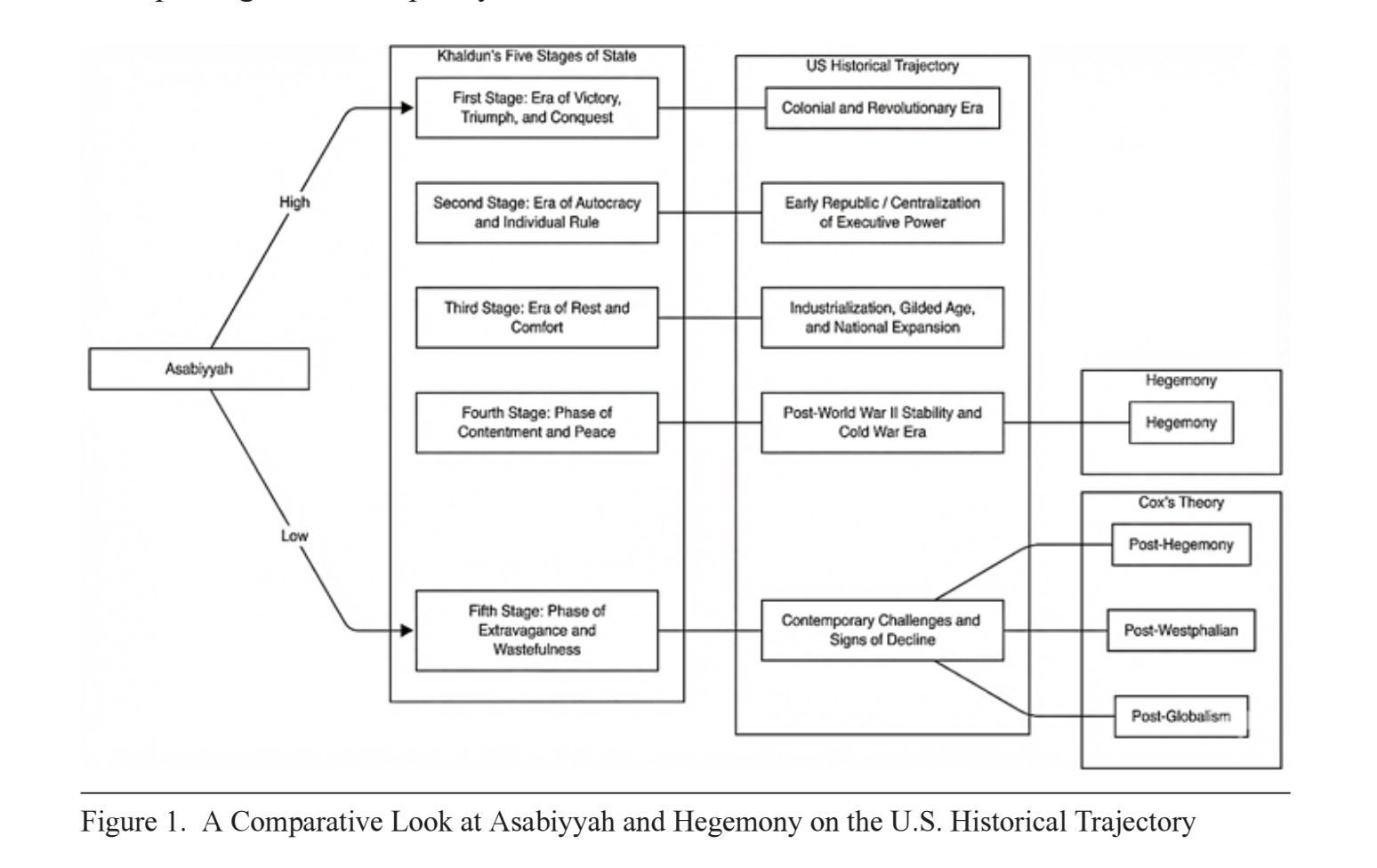
Note. The figure maps theories of the Khaldunian five stages of the state and the consolidation of domestic and international hegemonic power over time, tracking the U.S. trajectory from shared governance to centralization and eventual fragmentation.
In 1776, Thomas Paine in his Common Sense famously stated that “in America, the rule of law is king.” As Khaldun explains, a sovereign state (mulk) derives its legitimacy either from rational law or religious law. In the case of the U.S. Constitution, the basis for valid exercise of authority came from the natural law tradition in which the Constitution is rooted in the natural law tradition (Inlow, 1947; "Natural law and the Constitution," 1860) and was designed to function within a society shaped by religious and moral principles as John Adams emphasized and added that “it is wholly inadequate to the government of any other” (Adams, 1789). Similarly, Tocqueville highlights the role of religion “in the republic which they set forth in glowing colors than in the monarchy which they attack; and it is more needed in democratic republics than in any others” (Tocqueville, 1945, p. 318), paralleling Khaldun’s mention of religion as one of the colors of civilization that “eliminates the rivalry and envy that exists between the asabiyyah holders” (Haldun, 2004, p. 378).
Contrasting Protestantism with Catholicism, the latter is associated with monarchy, which ensures equality among people through obedience, whereas the former, linked to republicanism, prioritizes independence over equality. In the U.S. context, initially, religion and freedom coexist in harmony, but as democracy expands, the two gradually diverge (Tocqueville, 1945, pp. 311-317). As societies settle into urban life and luxury, religion transitions from an organic, mobilizing force into a learned and inherited cultural habit (Khaldun, 2015, p. 171), creating “lived religion in America” (Orsi, 1997, p. 16), religious practices that are linked to specific social contexts with time becoming habits through “modernization, urbanization, and industrialization” (Hervieu-Léger, 1997, p. 38). Although seldom examined in its political realm, these lived experiences become religious customs operating as civil religion; implicit religious values of a nation that “links itself to citizenship and provides content for its identitarian dimension” (Ferrari, 2010, pp. 749-750) determining who legally belongs yet culturally does not. Political behavior indicates instead of promotion of unity, civil religion has become a tool for political partisanship (Vegter et al., 2023). The gradual geographical divide of U.S. politics has turned into a stark urban-rural divide, creating rural grievances rooted in the materiality of perceived economic exclusion and cultural displacement (Mettler & Brown, 2022, pp. 130-135). Christian nationalism provides the social base and cultural frame that transforms these grievances. It achieves this by fusing material anxieties and rural resentment with a potent narrative of perceived injustice from the liberal establishment and the decline of America’s internal moral order. This process effectively translates disparate grievances into a structured political force and a cohesive, socially-shared identity. In the light of this, “Christian nationalism is better approached analytically as an active process of socially-shared identity formation than as a belief system or Gestalt of individual religious practices” (Miller, 2021, p. 64).
The direct influence between religion and politics in the U.S. was evident to Tocqueville in how Americans “worship from habit more than from conviction” and around a unity of Christian morality “there is no country in the world where the Christian religion retains a greater influence over the souls of men than in America” (Tocqueville, 1945, p. 314). Drawing on this connection, scholars such as Andrew C. McLaughlin linked Puritan covenants, which are influenced by Lutheran philosophical method, to American political institutions and national character, which led Robert N. Bellah to present this tradition as the legitimizing standard of the U.S. (Kessler, 1992). This highlights the historical intersection between law, sovereignty, and religious cohesion in governance— an intersection that has re-emerged in modern Christian nationalism with its attempts to revive this religious-based asabiyyah, asserting that national identity (Wolfe, 2022) and governance (Barton, 2007) must be rooted in Christian moral authority. Hence the ongoing legal battles over religious liberty are a part of a broader historical struggle over the nature of American identity and governance. Therefore, contemporary religious and political conflicts in the U.S. cannot be understood without recognizing the long-standing tensions within Protestantism and its disestablishmentarianism (Stolzenberg, 2025).
The emergence of Protestantism, as a reaction against the established Catholic Church, exemplified by Martin Luther’s Ninety-five Theses and further shaped by Calvinist doctrines played a significant role. The new Protestant ethos emphasized an individual and a gradually more private religious experience and the “priesthood of all believers,” thereby undermining traditional religious hierarchies and reinforcing a nascent national cohesion in Europe which was carried to the U.S. through this ethos, providing the cultural basis of early American nationalism that formed in opposition to external currents (Maguire, 2016, p. 179). Combined with colonial grievances such as those provoked by oppressive measures like the Stamp Act of 1765, these forces catalyzed the American Revolution and fostered a strong, collective identity rooted in both political and religious self-determination. As the ultimate goal of asabiyyah is to reach mulk (Haldun, 2004, p. 349), in this process, the settlers rejected the tyranny of a centralized British monarchy after a series of oppressive measures and with the Quebec Act in 1774, colonists rooted in a mix of religious, political, and legal concerns, saw the extension of Catholic rights as a threat of papal tyranny that might move into the American colonies ("Extracts from the votes," 1774, p. 2). It wasn’t until the Jacksonian years, which are now remembered as an authentic democratic movement, that Andrew Jackson’s centralization of power was being criticized for moving toward autocracy ("The political screw," 1834, p. 2).
This erosion of the foundational asabiyyah is most evident in the parallel philosophical and legal shifts that redefined the state. The move from static, universal truths toward dynamic, constructed realities and individualism mirrored a change in the understanding of law. This historical transition from Natural Law to Legal Positivism is a clear manifestation of the Khaldunian cycle. Natural law, which rooted authority in a shared moral consensus (a society shaped by religious and moral principles), represented the binding sabab asabiyyah of the early state (Stage 1). In contrast, Legal Positivism, which separates law from morality and bases it on habitual obedience to a sovereign, mirrors the autopoietic and hollow legal-rational mechanisms of a senile (Stage 5) state. This transition is the erosion of rational-legal legitimacy, as the law loses its connection to the collective asabiyyah and becomes a mere tool of state power, focusing on state-defined rights over a shared purpose.
A similar pattern of decay emerged in the economic sphere. Henry A. Wallace’s (1936) contemporary critique aligns directly with Khaldun’s analysis of luxury eroding cohesion. Wallace argued the Protestant ethic had yielded to the scientific management of surplus value, reorienting society toward commodified consumption and privileging the individual consumer over collective obligation. This shift from communal thrift (an early asabiyyah) to a Prosperity Gospel’s celebration of personal affluence is a textbook symptom of Khaldunian senility, where excessive consumption and dependency replace shared purpose, fostering the ‘individualism’ that defines a declining state.
Finally, this legal and economic fragmentation was mirrored by an epistemological one. The rise of existentialism, accelerated by the trauma of world wars, signaled the collapse of the asabiyyah as a shared moral or religious framework. While earlier revivals had reinforced collective identity, this new philosophy prioritized inwardness and the individual’s subjective relation to faith and the absence of inherent meaning. This fragmented search for meaning is the very definition of a late-stage, senile asabiyyah. It is this structural, legal, and epistemological vacuum, the result of the liberal order’s Khaldunian decline that the resurgence of Christian Nationalism attempts to fill.
The destabilization of institutional narratives, driven by the shift from natural law to legal positivism and the transformation of religion from communal to individual belief systems, has set the stage for epistemic crisis. Steve Tesich’s concept of post-truth, introduced in The Nation in 1992 (p. 12), described a departure from objective facts in favor of comforting narratives, a trend that gained prominence after the 2016 U.S. election and Brexit. While post-truth focuses on disinformation, some scholars emphasize post-trust as the deeper issue (Jones, 2023) —an institutional legitimacy crisis that fosters skepticism toward traditional authorities, including media, science, and government. Post-truth is a condition where multiple biases can coexist simultaneously while universality claims of any value system such as religion or ideology lose their ensuring power due to institutional destabilization, and it is the lack of a collective cohesive consensus on truth that feeds mistrust.
Modern nation-states are distinguished in their exercise of power not being based on overt coercion alone as “power depends solely on the belief of those who are subjected to it, that is to say on recognition” (Pallotta, 2015, p. 142). The nation legitimizes the state by recognizing its sovereignty. Still, contemporary conceptualizations seem to frame nationalism more strongly as a top-down process of hegemonic structure that crystallizes power and privileges certain identities that are not entirely artificial but emerge through a process of symbolic aggregation and dispersion (Anastasiou, 2022, pp. 15-18). In this context, consent is created by the disciplining power of institutions on the body and mind with its created regimes of truth that establish habitual obedience (Foucault, 1995). However, digital technology and globalization have disrupted these structures, accelerating an ideological shift toward neoliberalism and eroding institutional credibility. As a result, a legitimacy deficit created an autopoiesis, a social system that self-produces based on operational codes and boundaries, legitimizing itself (Luhmann, 1995, p. 274).
This analysis does not posit that disputes over truth are the primary cause of the legitimacy crisis. Rather, it argues that the post-truth and post-trust phenomena are the modern symptoms and accelerants of a much deeper, structural decay of the established liberal asabiyyah. In Khaldun’s model, the legitimacy crisis begins when the state enters senility (Stage 5) and the ruler, having consolidated power (istibdād), breaks the original shared purpose and collaboration (mushārakah) that once bound the elite.
When this foundational cohesion is lost, the lack of a collective cohesive consensus on truth is an inevitable outcome. Post-truth politics, as McIntyre (2018, pp. xiv-13) suggests, is therefore a tool used to exploit this pre-existing structural weakness, not its cause. Trump’s Executive Order 14176 (2025), which mandated the declassification of long-withheld federal documents, is a tactic that reinforces public skepticism by targeting the perceived disconnect and extravagance of the senile state. This erosion of trust opening the door for alternative forms of legitimation is reflected in the growing scholarship on Christian nationalism, moving beyond historical analyses of civil religion to critical examinations of its role in contemporary politics, as it is both a reaction to and a product of the broader legitimacy crisis, positioning itself as a means of reclaiming social and political cohesion in an era of uncertainty.
Having established the contemporary crisis of legitimacy and its manifestations in post-truth politics, we must now examine how Ibn Khaldun’s theoretical framework illuminates this crisis. The following section will demonstrate that what appears as a novel challenge to American democracy is, in fact, part of a recurring pattern of civilizational decline that Ibn Khaldun identified centuries ago. By applying his five-stage model to the American case, we can trace how the foundational asabiyyah that once unified the nation has progressively weakened, creating the conditions for Christian nationalism’s emergence as a rival form of social cohesion.
The emergence of contemporary Christian nationalism in the U.S. can be understood as part of a cyclical trajectory caused by the steering of economic, political, and socio-cultural transformations of asabiyyah. In its foundational phase, American identity was strengthened by early Protestantism and successive religious revivals. This sabab asabiyyah was both a continuation of the Protestant progression of human agency and a counterpoint to European secularism, as each civilization experienced a different stage in its asabiyyah cycle. As material conditions developed, transformations from the Protestant ethic to the Social Gospel and later the Prosperity Gospel reflected a gradual weakening of this initial communal solidarity.
As the world is witnessing deglobalization, which in turn drives an ongoing process of historical rupture characterized by economic realignments, geopolitical fragmentation, and a crisis of meaning, it is giving way to a complex and fragmented multi-world order that is taking shape (Okur, 2025). Forcing countries to adapt to the evolving dynamics of the broader international reordering in which the old normative foundations no longer sustain the unipolar system has contributed to a decline in support for U.S. global hegemony. Hegemony, derived from the concept of hegemonia (legitimated leadership) as distinct from arkhe (coercive control), is not merely a function of military might but “a structure of values and understandings about the nature of order that permeates a whole system of states and non-state entities” (Cox, 1992, p. 140). The decline of a hegemon and the aftermath of a hegemonic era are rather obscure. Yet, by moving beyond a narrow, problem-solving view of international order to analyze the broad, critical landscape of global politics, three possible outcomes arise: new hegemony, non-hegemonic world structure, counter-hegemony (Cox, 1981).
Moving away from international order, Cox comes to the conclusion of a post-hegemony by pointing to Ibn Khaldun. International order, in this view, is a subset or specific configuration within the larger transhistorical process of world order — one that prevails across all of humanity without being tied to specific institutions or historical conditions (Okur, 2015, pp. 131-151). Drawing on Cox’s structural critique but surpassing the limitation of exclusive-inclusive hegemony theory, this paper, by applying Khaldun’s insights, proposes an alternative analytical framework on the basis of asabiyyah to reconnect the hegemonically divided Western and non-Western worlds. Thus, by employing asabiyyah as a framework that emphasizes structural and sociological patterns, this approach transcends geographically and culturally bounded distinctions. It closes the epistemological gap not by integrating non-Western societies into Western-dominated knowledge production but by recasting hegemony as a transhistorical process to universalize theory. In doing so, it rejects the artificial core-periphery and West/Non-West divides, highlighting recurring patterns of cohesion, legitimacy, and authority that are central to understanding state behavior and political movements in international relations.
Cox further argues that the phase of post-hegemony happens along with post-Westphalia and post-globalism, suggesting that the disintegration of traditional hegemonic structures may pave the way for new forms of legitimacy other than the nation-state. This interpretation sets the stage for exploring how alternative sources of authority, such as Christian nationalism, might seek to fill this legitimacy vacuum in the U.S. From this point of view, Christian nationalism within the U.S. can be understood as an expression of asabiyyah aimed at establishing a new hegemonic order, in opposition to counter-hegemonic forces within a non-hegemonic world structure that is better expressed with the term multi-world order. Hence, post-hegemony is when the triumph of convincing ideology or culture as a stabilizer is lost.
Subsequently, the decline of a unifying hegemonic force is among the primary triggers of deglobalization; a fragmented international system where, according to an interpretation, the norm is “disembedded unilateralism,” is emerging (James, 2018, pp. 219-220). A postcolonial perspective is crucial to reveal the disintegrating order which was fundamentally shaped by the colonial encounter, as it challenges the fragmentation of history into two distinct, disconnected worlds. Acknowledging the connections between the West and non-West becomes paramount as neither have ever existed distinctly but have always been interconnected, shaping one another (Persaud & Sajed, 2018, p. 9). This interconnectedness makes asabiyyah a valuable analytical tool applicable to a variety of cases. The concept bridges disparate eras, revealing how the same macro patterns in transhistorical processes of social cohesion observed by Ibn Khaldun in North Africa recur in civilizational transformations, including those of the modern West. Within this framework, a weakened asabiyyah causes the legitimacy of authority to erode. The state must then rely on coercion, becoming brittle and vulnerable to being overthrown by a new group possessing a stronger, more robust asabiyyah.
Within the conjoint process, “deglobalization can be seen as a long-term, historical response to people’s loss of agency in making their own life-worlds” (Behera, 2021, p. 1589), and Christian nationalism as the defender of human agency (Torba, 2025) against both external existential techno-authoritarian threats and internal epistemological and ontological conflicts, such as those surrounding gender issues. This process is further accelerated by the intensifying competition in advanced technologies with the CEOs of American companies advocating for limited competition (Thiel, 2014) and export controls to preserve unipolarity (Amodei, 2025). Joe Biden’s (2025) farewell address echoing Eisenhower’s warning about the military-industrial complex, coupled with the notable presence of billionaires at Trump’s second inauguration (McGowan & Lowell, 2025), highlighted the rise of a tech-industrial complex in the U.S.
The internationalization of the state shapes Christian nationalist rhetoric, pivoting it toward a rejection of globalism and an embrace of the patriotic populism voiced by Donald Trump. This administrative doctrine (Moynihan & Roberts, 2021) creates a non-ideology-based political loyalty (Barber & Pope, 2019) known as “Trumpism.” At the domestic level, Trumpism represents a crisis of rational-legal legitimacy, where traditional institutions of bureaucracy, judiciary, and media are increasingly distrusted by a segment of the public. This distrust stems not necessarily from objective economic insecurity or political instability but rather from perceived economic exclusion and cultural displacement. Trumpism translates Christian-nationalist grievances into political loyalty and institutional delegitimation, while religious networks provide the social base and cultural frame to normalize these politics, hence making both movements mutually reinforcing (PRRI, 2025) around the shared purpose to attain state power.
Hegemony, as Gramsci argues, is sustained through a shared purpose that legitimizes its rule. However, as Ibn Khaldun observes, a waning asabiyyah inevitably faces challenges from emerging groups. In his 2025 Munich Security Conference speech, J.D. Vance implicitly frames Christian nationalism as a counterforce to the liberal establishment. The rhetorical shift from “MAGA” (Make America Great Again) to “MEGA” (Make Europe Great Again), echoed by Elon Musk, signals an effort to extend this asabiyyah beyond national boundaries, positioning Christian nationalism as a transnational movement aimed at restoring a perceived lost order.
Justice and solidarity are two sides of the same coin, one ensuring equal freedoms, the other the welfare of citizens bound by a shared way of life (Wilde, 2013). Solidarity can also emerge reactively from perceived injustice, not just from a positive pursuit of justice (Tava, 2021). Hence, Christian nationalism’s appeal can be seen as a form of reactive solidarity —mobilized by perceived injustices by the liberal establishment— seeking to restore cohesion amid legitimacy crises in the U.S. and to construct a world grounded in American-Christian values. Internationally, it responds to the perceived erosion of U.S. hegemony within the liberal world order; domestically, it resists the cultural and ideological hegemony of the liberal establishment. Thus, Christian nationalism emerges as a reaction[iii] to the decline of both America’s external authority and its internal moral order grounded in Christian values. In this sense, Christian nationalism represents a renewed form of asabiyyah, seeking to restore cohesion on two interconnected fronts.
The resurgence of Christian nationalism reflects a deeper legitimacy crisis within the U.S. nation-state, driven by growing disillusionment with secular governance and institutional instability. This crisis is not an isolated phenomenon but aligns with global trends of deglobalization, declining U.S. hegemony, and the erosion of rational-legal legitimacy. Within this framework, Christian nationalism seeks to redefine legitimacy by merging religious authority with state power, positioning itself as both a response to and a symptom of structural decline.
By applying Ibn Khaldun’s asabiyyah, this study reframes Christian nationalism as a mechanism of social cohesion rather than a static ideology. Asabiyyah, a force that historically binds groups together amid political fragmentation, explains why Christian nationalism has gained traction in the face of institutional mistrust and political polarization. Rather than viewing Christian nationalism as merely reactionary or atavistic, this framework situates it within a broader cycle of state formation and decline.
The historical trajectory of the U.S. reveals a pattern of asabiyyah-driven legitimacy shifts, where religious and civic nationalism once coexisted but have now entered a new phase of tension. Early American nationalism was shaped by disestablished Protestantism, which provided a unifying moral foundation without state enforcement. However, as modernization, pluralism, and legal positivism have weakened the initial social bonds, Christian nationalism has emerged as an attempt to reconstruct a new form of asabiyyah, shifting from cultural influence to institutional power.
Christian nationalism’s future remains uncertain. While it presents itself as a stabilizing force, its reliance on narratives of exclusion and historical revisionism may limit its capacity for broad-based social cohesion. The extent to which it can reshape American governance and identity depends on whether it solidifies a lasting legitimacy framework or becomes another transient force within the U.S.’s ongoing crisis of authority. What is clear is that Christian nationalism is not simply a cultural movement but an evolving response to the perceived failures of liberal democracy, demanding further scholarly attention beyond essentialist critiques.
This study highlights the need to move beyond secular-religious binaries in analyzing nationalism, integrating historical sociology to better understand contemporary movements. By bridging asabiyyah with modern political developments, this research offers a more dynamic lens for further studies assessing the transformations of legitimacy, power, and identity in an era of American political upheaval.
Notes
[i] Ibn Khaldun distinguishes between mulk (royal authority or sovereignty) and dawla (the political cycle or phase of rule). While mulk denotes the institutionalized possession of power established through asabiyyah, dawla represents the temporal trajectory of that rule—its rise, consolidation, and decline. Rosenthal translates these respectively as “royal authority” and “dynasty,” but this renders them too narrowly monarchical. In Khaldun’s theory, mulk signifies any form of concentrated political dominion, and dawla its cyclical unfolding. Both are forms that take shape depending on the matter; umran and its structural conditions. Applied analogically, mulk corresponds to the exercise of governing authority in modern polities, while dawla can be understood as the historical phase or regime-form through which an asabiyyah-based power is sustained or eroded (see Lewis, 1982, pp. 415-421; Orwin, 2018, p. 60).
[ii] In this passage, the pronoun “their” refers specifically to the townspeople (citadins). Lacoste (1984, pp. 128-130) maintains a distinction between the “urban population” as the structural-demographic aspect of umran hadari and the “townspeople” as the specific social actors whose economic behavior, characterized by a lack of productive creativity, drives civilizational stagnation. Lacoste (1984, pp. 65-79) also contrasts the terriens (rural or land-dwelling populations) with the townspeople on account of their possessed military potential. In doing so, he replaces the ethnic antagonism of the colonial Arab-Berber myth, suggesting that decline is a consequence of shifting material conditions and social agency rather than an ethnic trait. By centering the townspeople as the locus of this agency, Lacoste’s reading reframes luxury, which is often reduced to a subjective moral judgment or ethnic essentialism, as a structural-materialist process, thereby avoiding determinism common in traditional Khaldunian scholarship.
[iii] Complementing its well-established role as a pro-active, state-building force, Ibn Khaldun's concept of asabiyyah also draws its generative strength from a reactive solidarity—a defensive group cohesion mobilized against perceived external threats or internal fragmentation: “This shows most clearly what group feeling [asabiyyah] means. Group feeling [asabiyyah] produces the ability to defend oneself, to offer opposition, to protect oneself, and to press one’s claims…” (see Khaldun, 2015, p. 111).

